
Competencies
- PY1.9 Demonstrate the ability to describe and discuss the methods used to demonstrate the functions of the cells and its products, its communications and their applications in Clinical care and research
Introduction
- Physiology forms the scientific core of medicine. It explains how the human body functions in health and disease. A clear understanding of physiological principles supports clinical learning, guides medical practice, advances research, and provides the foundation for disease prevention and health promotion.
- Physiology is the branch of biological science that studies the functions of living organisms and the mechanisms that regulate these functions.
- It explains how cells, tissues, organs, and organ systems perform their specific activities to sustain life.
- Physiology focuses on the mechanisms of body processes, including how these processes are initiated, controlled, and coordinated. It also examines the regulatory systems, such as the nervous system and endocrine system, that maintain stability within the body.
- A central concept in physiology is homeostasis, which refers to the maintenance of a relatively constant internal environment despite external changes.
- Physiological processes involve complex interactions among biochemical reactions, cellular activities, and organ system functions.
- Human physiology specifically studies the functional activities of the human body, including how organ systems integrate to maintain normal health.
- In medicine, knowledge of physiology forms the foundation for understanding disease mechanisms, diagnosis, and therapeutic interventions.
- Understanding physiological principles, such as coronary circulation, cardiac electrophysiology, and myocardial perfusion, helps clinicians interpret clinical signs, diagnose conditions like acute myocardial infarction, and guide effective treatment.
Physiology For Learning Medicine
- Physiology explains the normal functions of the human body and the mechanisms that maintain a stable internal environment.
- The stability of the internal environment is known as homeostasis. It represents the coordinated regulation of body systems that maintains internal balance despite external or internal changes.
- Disease often develops when this balance is disturbed for a prolonged period. Such disturbances produce functional abnormalities in organs or systems.
- Understanding the nature of these disturbances helps explain the pathophysiology of diseases and guides appropriate medical management.
- Therefore, a strong foundation in systemic physiology is essential for learning any clinical specialty. It helps physicians understand the mechanisms, diagnosis, and treatment of diseases.
- For example, effective management of acute myocardial infarction requires knowledge of coronary circulation, myocardial oxygen supply, cardiac electrophysiology, and regulation of coronary blood flow.
- This knowledge helps clinicians interpret ECG changes, understand the origin and radiation of ischemic cardiac pain, and select drugs that restore myocardial perfusion and limit tissue damage.
- Thus, physiological principles form the scientific basis for clinical decision-making in many diseases.
- A sound understanding of physiology also supports learning of other medical disciplines.
- Pharmacology largely applies physiological principles to explain how drugs modify normal body functions. For instance, β-adrenergic agonists relieve bronchial asthma by relaxing bronchial smooth muscle through sympathetic receptor activation.
- Similarly, physiology assists in understanding pathology. Acute infections typically show abundant neutrophils, whereas chronic inflammation commonly shows macrophages or monocytes.
- The mechanisms of disease causation, clinical manifestations, diagnostic findings, and therapeutic approaches all depend on physiological principles.
- For this reason, clinical physiology forms an important foundation in disciplines such as medicine, surgery, pediatrics, cardiology, pulmonology, endocrinology, and many others.
Physiology For Medical Practice
- Knowledge of physiology helps physicians understand the scientific principles that guide medical practice and disease management.
- Understanding physiological mechanisms enables clinicians to analyze symptoms accurately and select appropriate therapeutic strategies.
- Modern practice sometimes emphasizes rapid symptomatic relief through multiple medications, but unnecessary drug use may not provide long-term benefit.
- Many disorders improve through the body’s natural healing processes when supported by appropriate lifestyle measures and limited medication.
- For example, early hypertension can often be controlled through reduced salt intake, regular physical activity, stress management, and a balanced diet.
- These non-pharmacological measures improve cardiovascular regulation and may lower blood pressure without immediate drug therapy.
- Medications should be introduced only when lifestyle modifications fail to achieve adequate control.
- Physiological understanding also emphasizes the importance of immune responses in recovery from infections.
- Fever during infection is a protective physiological reaction that restricts microbial growth.
- In mild infections, observation and symptomatic treatment may be sufficient, while antibiotics should be reserved for definite indications.
- Knowledge of pathophysiology explains how disturbances in normal body functions produce disease.
- This understanding allows physicians to identify effective preventive measures.
- Regular exercise, balanced nutrition, and stress control improve metabolic and cardiovascular health.
- Such healthy habits reduce the risk of atherosclerosis and other metabolic diseases and form the foundation of preventive medicine.
Physiology For Medical Research
- Physiology forms the scientific foundation of modern medical research.
- Many major advances in medicine have originated from discoveries in physiological mechanisms and regulation of body functions.
- Research in physiology explains the etiopathogenesis of diseases and clarifies the physiological basis of clinical treatment.
- Basic physiological research investigates the mechanisms that regulate normal body functions and explains how these mechanisms become altered in disease.
- Clinical research applies this knowledge to develop improved methods for diagnosis, treatment, and prevention.
- Collaboration between physiology departments and clinical specialties promotes meaningful translational research.
- Such interdisciplinary work strengthens scientific understanding and encourages clinicians to participate in research activities.
- The ultimate aim of medical research is to reduce suffering, enhance recovery, prevent disease, and promote overall health in individuals and communities.
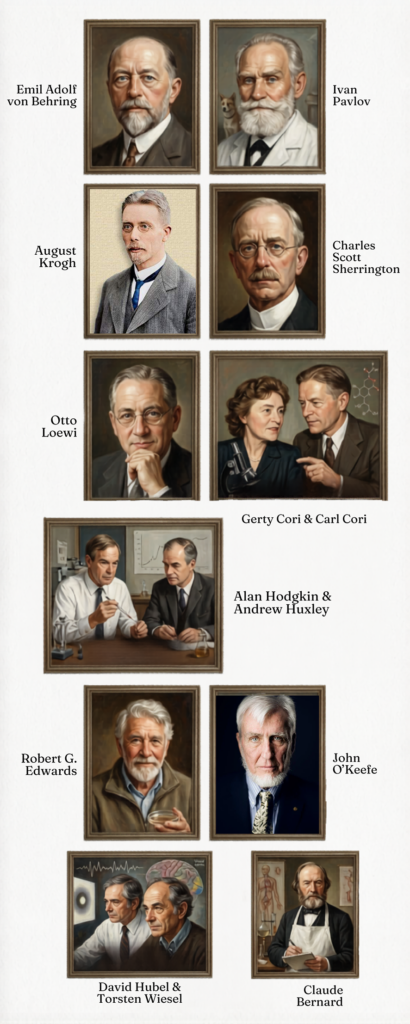
- Many scientists transformed physiology into a scientific discipline that explains body function from molecular and cellular mechanisms to integrated systems, forming the foundation of modern medicine, diagnostics, and therapy (Table 1.1.1).
Table: 1.1: Physiologists – as Scientific contributors to modern medicine
| Physiologist | Nobel Prize (Year) | Awarded For | Major Contribution to Physiology / Medicine |
|---|---|---|---|
| Emil Adolf von Behring | 1901 | Serum therapy against diphtheria | Demonstrated principles of immunity and developed antitoxin therapy; pioneered serum therapy and immunophysiology. |
| Ivan Pavlov | 1904 | Physiology of digestion | Studied gastric secretion and digestive regulation; discovered conditioned reflexes, establishing experimental neurophysiology of behavior. |
| August Krogh | 1920 | Regulation of capillary circulation | Explained how capillaries regulate oxygen supply in tissues; foundational work in microcirculation physiology. |
| Charles Scott Sherrington | 1932 | Functions of neurons | Introduced the concept of synapse and described integrative action of the nervous system. |
| Otto Loewi | 1936 | Chemical transmission of nerve impulses | Demonstrated that neurotransmission occurs through chemical mediators such as acetylcholine. |
| Gerty Cori & Carl Cori | 1947 | Glycogen metabolism | Discovered the Cori cycle explaining carbohydrate metabolism between muscle and liver. |
| Alan Hodgkin & Andrew Huxley | 1963 | Ionic mechanisms of nerve impulses | Explained ionic basis of action potentials using squid giant axon experiments. |
| David Hubel & Torsten Wiesel | 1981 | Processing of visual information | Demonstrated how neurons in the visual cortex respond to orientation and movement of visual stimuli. |
| Robert G. Edwards | 2010 | Development of in vitro fertilization | Advanced reproductive physiology and infertility treatment through IVF technology. |
| John O’Keefe | 2014 | Brain’s positioning system | Discovered place cells in the hippocampus that create spatial navigation maps. |
| Claude Bernard | — | — | Introduced the concept of milieu intérieur, forming the physiological basis of homeostasis and experimental medicine. |
📝 Test Your Knowledge – Practice MCQs
Attempt the chapter MCQ quiz and assess your understanding of key concepts.
Click to see: Medical Disclaimer and Copyright Notice