
Competencies
- PY1.2 Describe and discuss the principles of homeostasis
Introduction
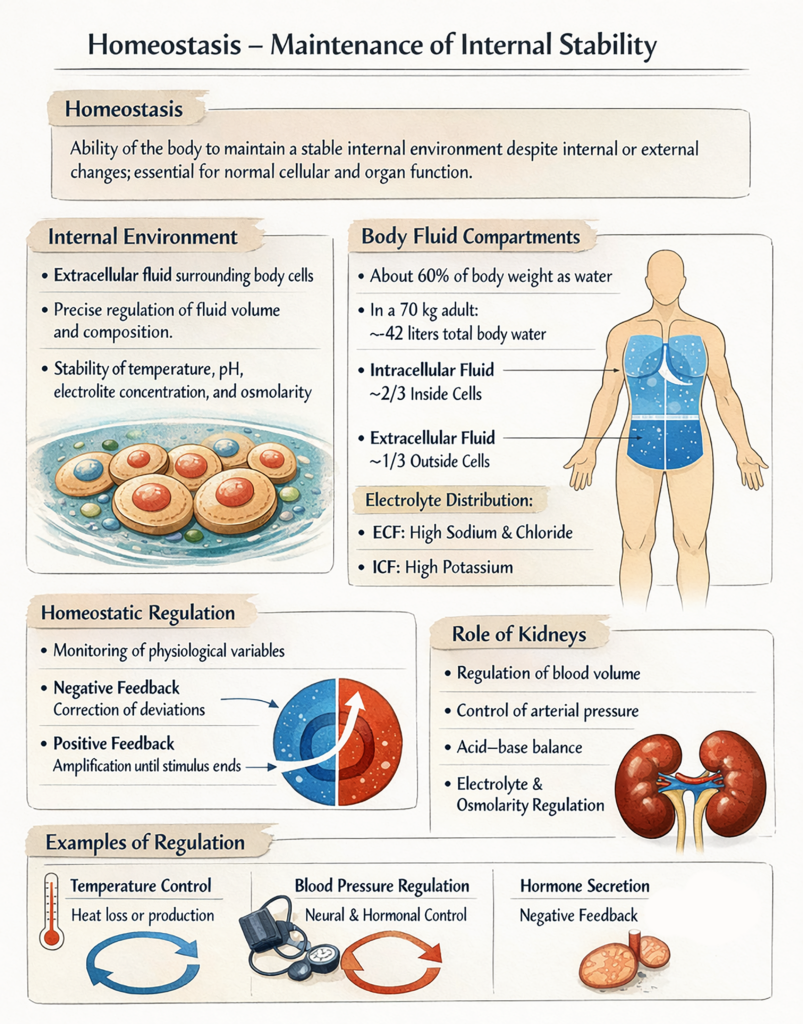
- Homeostasis refers to the body’s ability to maintain a stable internal environment despite external or internal changes. This stability is regulated through coordinated feedback mechanisms, mainly negative and positive feedback, which continuously adjust physiological functions to preserve normal body conditions.
- · The kidneys play a crucial role in maintaining homeostasis. They regulate blood volume, arterial pressure, acid–base balance, electrolyte composition, and osmolarity of body fluids to preserve internal stability.
Concept of Homeostasis
- Homeostasis refers to the ability of the body to maintain a stable internal environment despite variations in external conditions.
- The constancy of this internal environment is essential for normal cellular function and overall survival.
- The internal environment mainly consists of extracellular fluid (ECF) that surrounds and supports body cells.
- The volume and composition of this fluid are carefully regulated to remain within narrow physiological limits. This regulation ensures that essential variables such as temperature, pH, and electrolyte concentration remain stable
- A clear distinction exists between intracellular fluid (ICF) inside the cells and extracellular fluid outside the cells
- The ability to maintain a constant internal environment allows the body to function effectively even when external environmental conditions change.
Extracellular Fluid as the Internal Environment
- Water distribution: About 60% of body weight in adults consists of water, which forms the body’s fluid compartments. In a person weighing about 70 kg, total body water is approximately 42 liters. Nearly two-thirds of this water is present inside cells as intracellular fluid (ICF). The remaining one-third forms extracellular fluid (ECF), which surrounds and supports body cells.
- The electrolyte composition of ECF is characterized by high concentrations of sodium and chloride.
- In contrast, ICF contains higher concentrations of potassium and lower levels of sodium and chloride. The ECF acts as the body’s internal environment, providing nutrients, oxygen, and ions required for cellular function.
- Homeostasis refers to the coordinated physiological mechanisms that maintain the stability of this internal environment.
Homeostatic Mechanisms
- Homeostasis refers to the maintenance of a stable internal environment within the body.
- It involves regulation of the composition of body fluids and the control of important physiological variables. Key variables such as temperature, electrolyte concentration, and acidity of body fluids must remain within narrow limits.
- Proper regulation of these factors ensures normal cellular activity and coordinated organ function.
- The stability of extracellular fluid is especially important because it directly surrounds and supports body cells.
- Various regulatory systems continuously monitor and adjust these variables through integrated physiological mechanisms.
- Disturbances in these regulatory processes lead to imbalance in the internal environment. Such disturbances can impair normal body function and contribute to the development of disease.
Feedback Mechanisms of Homeostatic Regulations
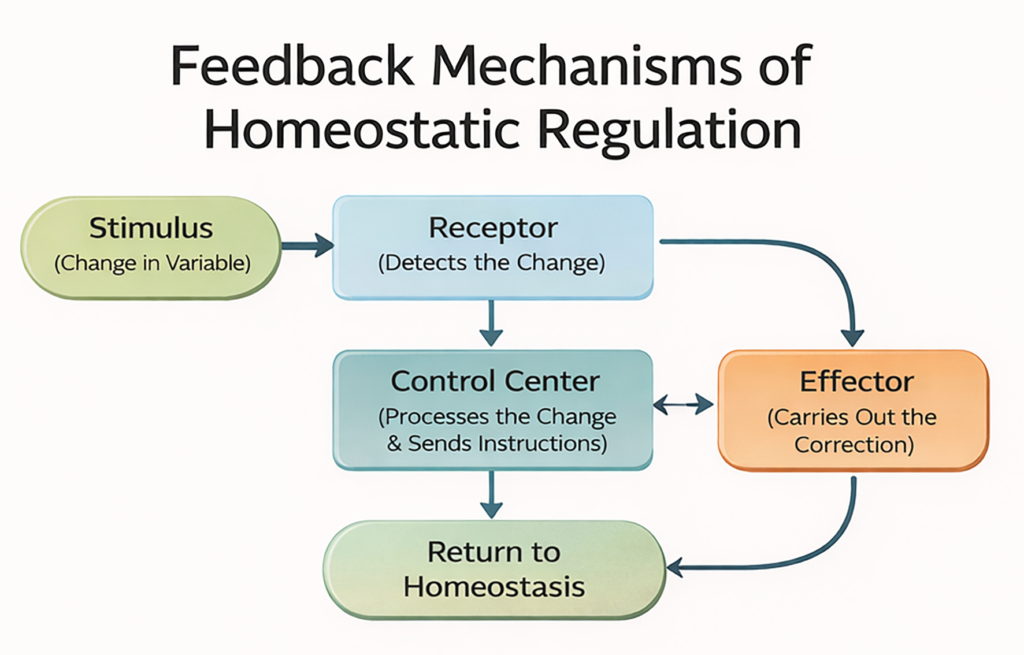
- Homeostatic regulation is maintained mainly through feedback mechanisms that keep physiological variables close to a defined set point. Any change in a variable acts as a stimulus and is detected by specialized receptors. These receptors activate regulatory pathways that generate appropriate responses.
- The responses adjust body functions to restore the variable toward its normal range. This process maintains the stability of the internal environment.
- Two principal types of feedback regulation operate in the body: negative feedback and positive feedback.
Negative Feedback
- Negative feedback is the most common mechanism that maintains homeostasis.
- When a physiological variable rises above the set point, regulatory responses reduce its level.
- When the variable falls below the set point, corrective processes increase its level. These adjustments restore the variable toward its normal range and maintain stability of the internal environment.
Positive Feedback System
- Positive feedback occurs when an increase in a physiological variable stimulates processes that further increase the same variable.
- This mechanism amplifies the response instead of restoring stability of the internal environment.
- The cycle continues until the stimulus stops or the process naturally terminates.
- Examples:
- During parturition, cervical stretching stimulates oxytocin release, which strengthens uterine contractions until delivery occurs.
- A surge of luteinizing hormone before ovulation is produced by positive hormonal feedback.
- Opening of sodium channels during action potential depolarization promotes further channel activation.
- Activation of clotting factors in the coagulation cascade proceeds through sequential enzyme activation.
Negative Feedback System
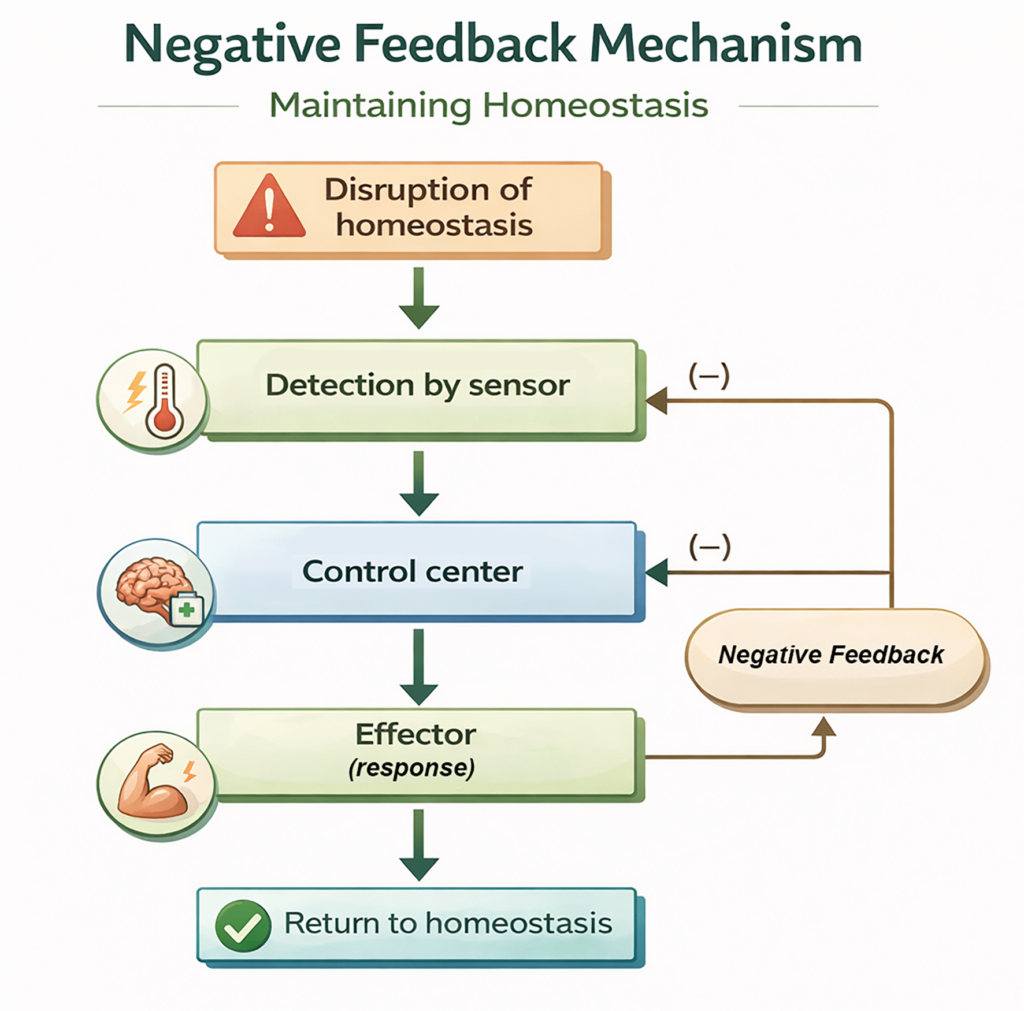
- Negative feedback is a primary mechanism that maintains stability of physiological variables within a normal range. This regulatory system operates through three main components: sensor, control center, and effector.
- The sensor detects deviations of a physiological variable from its normal level. Specialized receptors transmit this information to the regulatory center.
- Examples include baroreceptors located in the carotid sinus and aortic arch, which monitor changes in arterial pressure.
- The control center, usually located in the brain, interprets sensory input and determines the appropriate corrective response.
- Important regulatory centers involved in cardiovascular control are present in the medulla and hypothalamus.
- The effector is the target organ that produces the response required to restore the variable toward the normal range.
- In blood pressure regulation, the heart and blood vessels act as effectors. These organs adjust their activity through changes in autonomic nervous system signals.
- If the variable rises above the set point, corrective responses reduce it. If the variable falls below the set point, responses increase it until normal balance is restored. Some physiological variables, such as arterial pressure, are controlled by multiple regulatory mechanisms working together.
Clinical Physiology
- Life-preserving regulatory mechanisms receive priority over routine physiological controls. During extreme environmental exposure, maintenance of body temperature takes precedence over regulation of body water balance. Protective responses such as the withdrawal reflex are activated rapidly to prevent tissue injury.
Examples of Homeostatic Regulations
- Homeostasis maintains stability of the internal environment by regulating pH, osmolarity, water content, electrolytes, blood glucose, and body weight. The exmaples of homeostatic regulation are as follows:
- Regulation of Body Temperature
- Core body temperature is maintained within a narrow physiological range.
- Elevated temperature activates mechanisms that increase heat loss through cutaneous vasodilation and sweating.
- Reduced temperature triggers heat conservation through vasoconstriction and increases heat production through shivering.
- Regulation of Blood Pressure
- Arterial blood pressure is maintained within a normal physiological range to ensure adequate tissue perfusion.
- Persistent elevation results in hypertension, whereas abnormally low pressure results in hypotension.
- Neural and hormonal regulatory mechanisms act continuously to stabilize blood pressure.
- Regulation of Hormone Secretion
- Many endocrine glands regulate hormone output through negative feedback mechanisms.
- Increased hormone levels suppress further secretion, while decreased levels stimulate additional production.
- This regulatory principle forms the basis for diagnosing several endocrine disorders.
- Regulation of Body Temperature
Intracellular Homeostasis
- Homeostasis maintains stable conditions not only in extracellular fluid but also within cells.
- The primary goal of regulation is preservation of intracellular homeostasis, which supports normal cellular and organ function.
- Cellular metabolism and enzyme activity regulate intracellular pH, temperature, and electrolyte balance such as sodium and potassium levels.
- Changes in extracellular fluid composition influence the intracellular environment.
- Stable physiological function requires coordinated regulation between intracellular and extracellular compartments.
Important Questions
- Define homeostasis.
- Describe important examples of homeostatic regulation in the human body.
- What are feedback mechanisms in physiology.
- Explain the negative feedback mechanism with suitable examples.
📝 Test Your Knowledge – Practice MCQs
Attempt the chapter MCQ quiz and assess your understanding of key concepts.
Click to see: Medical Disclaimer and Copyright Notice