
Competencies
- AN80.4: Describe embryological basis of twinning in monozygotic and dizygotic twins.
Introduction
- In humans, typically one ovum is released during each menstrual cycle, so most pregnancies involve a single fetus (singleton pregnancy).
- A pregnancy in which a mother carries two or more fetuses simultaneously is termed a multiple pregnancy.
- In contrast, many mammals such as dogs and cats commonly produce multiple offspring in a single gestation.
- When a pregnancy results in the birth of two offspring, it is referred to as twinning.
- The likelihood of multiple gestation increases with assisted reproductive techniques, particularly in vitro fertilization (IVF), because more than one embryo may implant in the uterus.
- Consequently, the incidence of twin pregnancies is higher following IVF than in natural conception.
Classification Of Twins
Multiple pregnancy refers to the development of more than one fetus during a single gestation. It can be classified according to the number of offspring or the genetic origin of the embryos.
Based on the Number of Offspring
Multiple pregnancies are described according to the number of fetuses present:
- Twins – two offspring
- Triplets – three offspring
- Quadruplets – four offspring
- Quintuplets – five offspring
Based on Genetic Origin
Multiple pregnancies may also be classified by the number of zygotes formed:
- Monozygotic twins – Develop from a single fertilized ovum (one zygote) that later divides into two embryos. These twins are genetically identical.
- Dizygotic twins – Form when two separate oocytes are fertilized by two different spermatozoa, producing two zygotes. These twins are genetically similar to ordinary siblings.
- Trizygotic or higher-order multiples – Occur when three or more oocytes are fertilized by different spermatozoa, producing multiple genetically distinct embryos.
Special Forms of Multiple Conception
- Superfecundation – In polyovulatory species, several ova released during the same reproductive cycle may be fertilized by sperm from different male partners. The resulting fetuses usually have the same gestational age.
- Superfetation – A rare phenomenon in which ovulation and fertilization occur during an ongoing pregnancy, leading to embryos with different gestational ages. This condition is extremely uncommon in humans but may occur in certain animals.
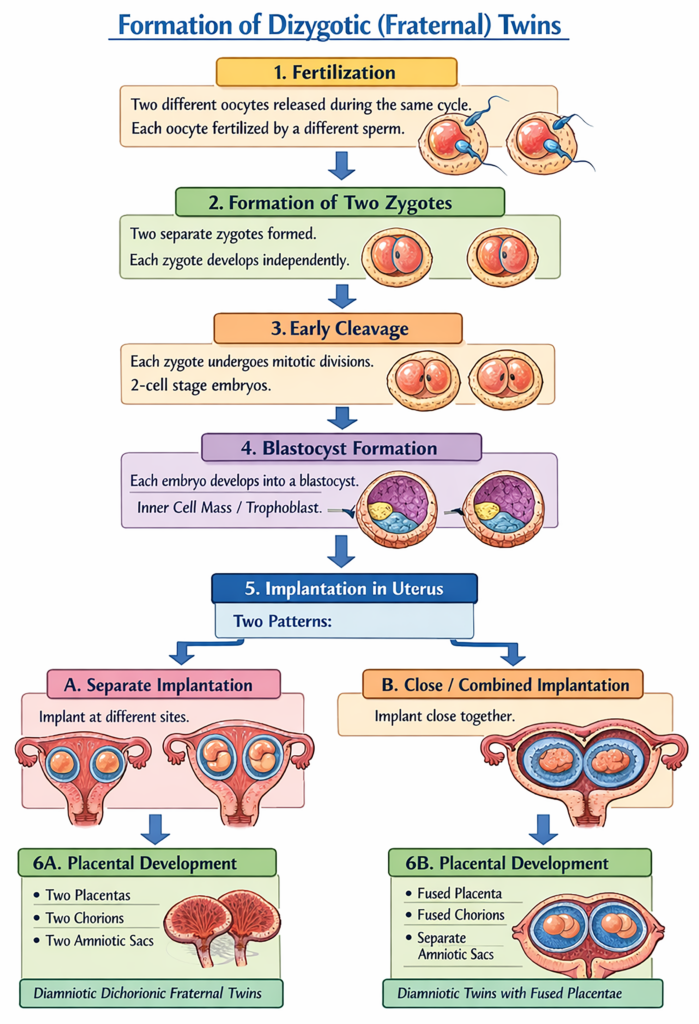
Dizygotic (Fraternal) Twins
Definition: Dizygotic twins arise when two separate oocytes are fertilized by two different spermatozoa, resulting in the formation of two independent zygotes. The term fraternal indicates that the twins are genetically similar to ordinary siblings rather than identical.
Incidence: The occurrence is approximately 7–10 per 1000 births, and the frequency tends to increase with advancing maternal age.
Features
- Dizygotic twins (also called diovular or divitelline twins) usually show phenotypic differences and may be of different sexes.
- Their genetic makeup is comparable to that of siblings born at different times.
- Each fetus typically develops with its own placenta, chorion, and amnion, forming separate fetal membranes.
- Two distinct gestational sacs are present within the uterus.
- If the placentas lie close together, they may appear fused, although they remain functionally separate.
- Approximately two-thirds of human twin pregnancies are dizygotic.
Monozygotic (Identical) Twins
Definition: Monozygotic twins (also called monoovular or monovitelline twins) arise from the fertilization of one oocyte by a single sperm, producing one zygote.
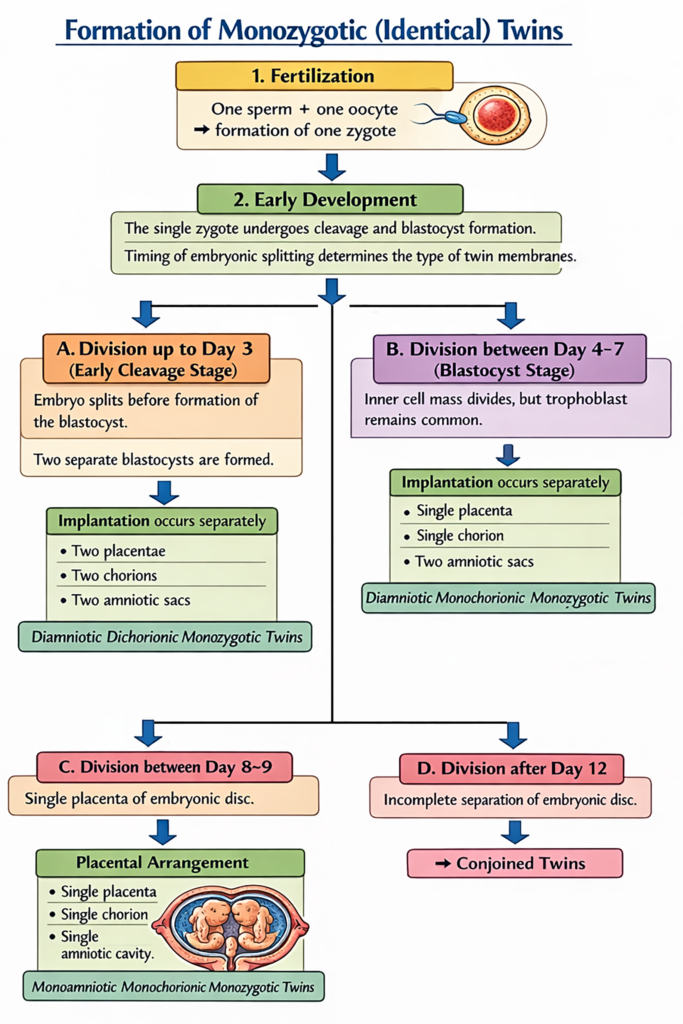
During early embryonic development, the blastocyst forms with an inner cell mass (embryoblast). If this inner cell mass divides into two separate embryonic groups, two genetically identical embryos develop, resulting in monozygotic twins.
Incidence: Monozygotic twinning occurs in approximately 3 per 1000 births.
Features
- Monozygotic twins are usually phenotypically similar and are always of the same sex.
- They possess an identical genetic composition because both originate from the same zygote.
- Depending on the timing of embryonic division, they may share the placenta, chorion, or amniotic cavity.
- Approximately one-third of all human twin pregnancies are monozygotic.
Classification Of Monozygotic Twins According To Degree Of Separation
- Monozygotic twins arise from a single fertilized ovum (zygote). Their structural arrangement depends on the timing of embryonic division during early development. Earlier separation produces more independent fetal membranes, whereas later division results in greater sharing of structures.
1. Diamniotic Dichorionic Twins
- These twins are also termed bichorionic diamniotic twins.
- They form when the zygote divides within the first three days after fertilization, before the development of the chorion and amnion.
- As a result, each embryo develops with its own chorionic sac, amniotic sac, and placenta.
- Although placentas may occasionally appear fused, they remain structurally separate. This arrangement occurs in approximately 25% of monozygotic twin pregnancies. (Most dizygotic twins are also dichorionic and diamniotic.)
2. Diamniotic Monochorionic Twins
- In this type, separation occurs between the 4th and 7th day after fertilization, when the inner cell mass of the blastocyst divides into two embryonic groups.
- The twins share a single chorionic sac and placenta, but each fetus develops within a separate amniotic sac.
- This is the most common form of monozygotic twinning, accounting for approximately 70–75% of cases.
3. Monoamniotic Monochorionic Twins
- These twins develop when embryonic division occurs around the 8th to 9th day after fertilization.
- Both embryos share the same chorionic sac, amniotic cavity, and placenta.
- This configuration is relatively uncommon and represents about 1–2% of monozygotic twin pregnancies.
4. Conjoined Twins (Siamese twins)
- If separation of the embryonic disc occurs after the 12th day following fertilization, the division is incomplete, resulting in conjoined twins.
- In this condition, the twins remain physically connected at specific body regions because the embryos fail to separate completely.
Classification of conjoined monozygotic twins
Conjoined twins are a rare form of monozygotic twinning in which incomplete separation of the embryo results in physical fusion. They are classified according to the anatomical site and extent of union between the two bodies.
- Craniopagus – The twins are joined at the skull, with fusion involving portions of the cranial bones.
- Thoracopagus – Fusion occurs at the anterior thoracic wall, often extending into the upper abdominal region up to the umbilicus. This is one of the most common forms of conjoined twinning.
- Omphalopagus – The twins are connected at the lower abdominal wall, usually around the umbilical region, while the thoracic structures remain separate.
- Cephalothoracopagus – There is combined fusion of the head and thoracic regions, resulting in extensive union of the upper body.
- Pygopagus – The twins are joined at the sacral or gluteal region, typically involving the lower spine and adjacent soft tissues.
- Ischiopagus – Fusion occurs at the pelvic region, particularly around the ischial bones. The twins are often positioned with their vertebral axes oriented approximately 180° to each other.
- Parasitic twins – A form of asymmetrical conjoining in which one well-developed twin (autosite) supports a smaller, incompletely formed twin (parasitic twin) that depends on the larger twin for survival.
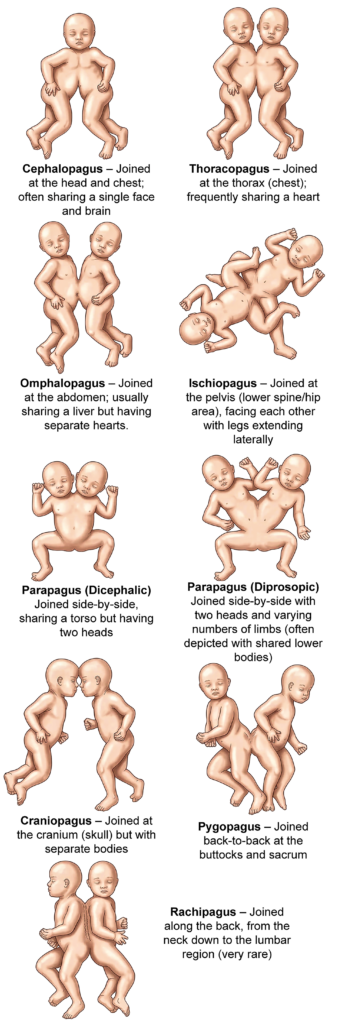
Table 10.1: Differences between monozygotic and dizygotic twins
| Feature | Monozygotic Twins (Identical) | Dizygotic Twins (Fraternal) |
|---|---|---|
| Origin | Single zygote splits into two embryos | Two separate zygotes formed |
| Fertilization | One ovum + one sperm | Two ova + two sperms |
| Incidence | Rare (~3/1000 births) | More common (~7–10/1000 births) |
| Genetic Makeup | Genetically identical | Genetically different |
| Sex | Always same sex | Same or different sex |
| Appearance | Very similar physical features | Resemble ordinary siblings |
| Placenta | Usually single placenta (may vary) | Two placentae (may fuse) |
| Chorion | Mono- or dichorionic | Always dichorionic |
| Amnion | Mono- or diamniotic | Always diamniotic |
Important Questions
- List the key differences between monozygotic (identical) twins and dizygotic (fraternal) twins with respect to their origin, genetic similarity, and developmental characteristics.
- Write a short note explaining the formation, genetic characteristics, and basic embryological features of dizygotic twins.
- Write a short note explaining the formation, genetic characteristics, and basic embryological features of moniozygotic twins.
- List the differences between monozygotic and dizygotic twins.
📝 Test Your Knowledge – Practice MCQs
Attempt the chapter MCQ quiz and assess your understanding of key concepts.
Click to see: Medical Disclaimer and Copyright Notice