
Competencies
- AN9.1: Describe attachment, nerve supply, and action of pectoralis major and pectoralis minor.
- AN10.11: Describe and demonstrate attachment of serratus anterior with its action.
- AN13.7: Identify and demonstrate surface projection of: Cephalic and basilic vein, Palpation of Brachial artery, Radial artery, Testing of muscles: Trapezius, pectoralis major, serratus anterior, latissimus dorsi, deltoid, biceps brachii, Brachioradialis. This chapter includes pectoralis major and minor, and serratus anterior muscles and their clinical testing.
Introduction
- The pectoral region is located on the anterior aspect of the trunk, in front of the thoracic cage, and forms the chest region.
- This region provides an important anatomical connection between the upper limb and the anterolateral wall of the thorax.
- It contains several structures that contribute to the stability and movement of the shoulder girdle and upper limb.
- The mammary gland (breast) is an important structure of the pectoral region and occupies the superficial fascia over the anterior thoracic wall.
- The principal muscles of the pectoral region are the pectoralis major, pectoralis minor, subclavius, and serratus anterior muscles.
- The pectoralis major is the largest muscle of the region and plays a major role in movements of the shoulder joint.
- The pectoralis minor and subclavius muscles help stabilize the scapula and clavicle during upper limb movements.
- The serratus anterior anchors the scapula against the thoracic wall and assists in its upward rotation during elevation of the upper limb.
- The region also contains the pectoral fascia and clavipectoral fascia, which surround and support the muscles while providing pathways for blood vessels, nerves, and lymphatics.
Surface Landmarks
- Surface landmarks provide an important guide for correlating external body features with the underlying gross anatomy during clinical examination.
- Only a limited number of structures located beneath the skin can be directly palpated or identified as visible surface projections.
- These palpable structures serve as reference points for estimating the position of deeper anatomical structures during physical examination.
- Surface landmarks are also valuable for planning surgical incisions, performing diagnostic procedures, and locating important anatomical structures accurately.
- The pectoral region contains several clinically significant bony and soft tissue landmarks that should be identified during routine examination.
Bony landmarks
- The clavicle lies horizontally at the root of the neck and extends between the sternum and the scapula.
- Because the clavicle is entirely subcutaneous, it can be palpated throughout its entire length.
- The clavicle serves as an important landmark for locating structures in the neck, shoulder, and upper thoracic region.
- The sternum is a flat bone situated subcutaneously in the anterior midline of the thorax.
- It consists of three parts: the manubrium, the body, and the xiphoid process.
- The sternum provides attachment for ribs, clavicles, and several muscles of the thoracic wall.
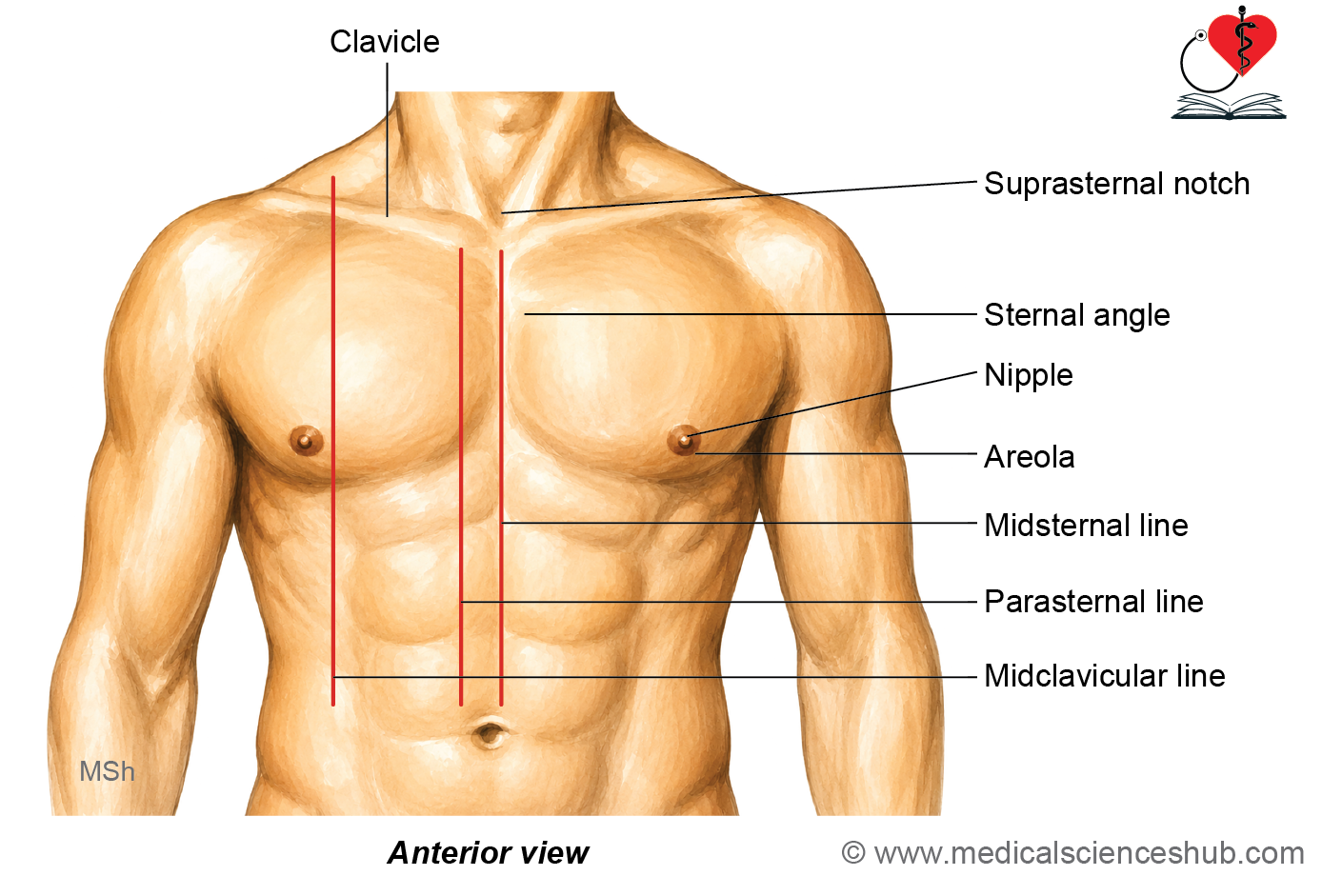
- The suprasternal notch, also called the jugular notch or interclavicular notch, is a palpable depression located between the medial ends of the clavicles above the superior border of the manubrium.
- This notch serves as an important surface landmark during clinical examination of the neck and thorax.
- The sternal angle is a palpable transverse ridge situated approximately 5 centimetres inferior to the suprasternal notch.
- The second costal cartilage articulates with the sternum at the level of the sternal angle on each side.
- This relationship makes the sternal angle the standard starting point for counting ribs and intercostal spaces during clinical examination.
- The sternal angle corresponds approximately to the level of the lower border of the fourth thoracic vertebra.
- The acromion process of the scapula forms the highest point of the shoulder and can be easily palpated.
- The tip of the coracoid process can usually be palpated about 2 to 3 centimetres inferior to the clavicle within the infraclavicular fossa, although deep palpation is generally required.
- The costal margin forms the inferior border of the thoracic cage.
- It is formed by the seventh to tenth costal cartilages together with the anterior ends of the eleventh and twelfth ribs.
Soft tissue landmarks
- The nipple is generally located near the fourth intercostal space, approximately 10 centimetres lateral to the midsagittal plane in adult males.
- The nipple is surrounded by a pigmented circular area known as the areola.
- The position of the nipple varies considerably, even among healthy adult males, and should not be used for rib counting or precise anatomical localization.
- The infraclavicular fossa, also known as the deltopectoral triangle, is a triangular depression located inferior to the junction of the lateral one-third and medial two-thirds of the clavicle.
- Its medial boundary is formed by the pectoralis major muscle.
- Its lateral boundary is formed by the deltoid muscle.
- Its superior boundary, or base, is formed by the clavicle.
- In well-developed individuals, the borders of the pectoralis major and deltoid muscles can usually be identified clearly on surface examination.
Anatomical lines
- The thoracic and pectoral regions are clinically examined using several vertical imaginary anatomical reference lines.
- These reference lines assist in describing the location of organs, lesions, and clinical findings accurately.
- The midsternal line passes vertically through the midpoint of the sternum along the midsagittal plane.
- The parasternal line runs vertically along the lateral border of the sternum on each side.
- The midclavicular line extends vertically through the midpoint of the clavicle and usually passes near the tip of the ninth costal cartilage and the midinguinal point.
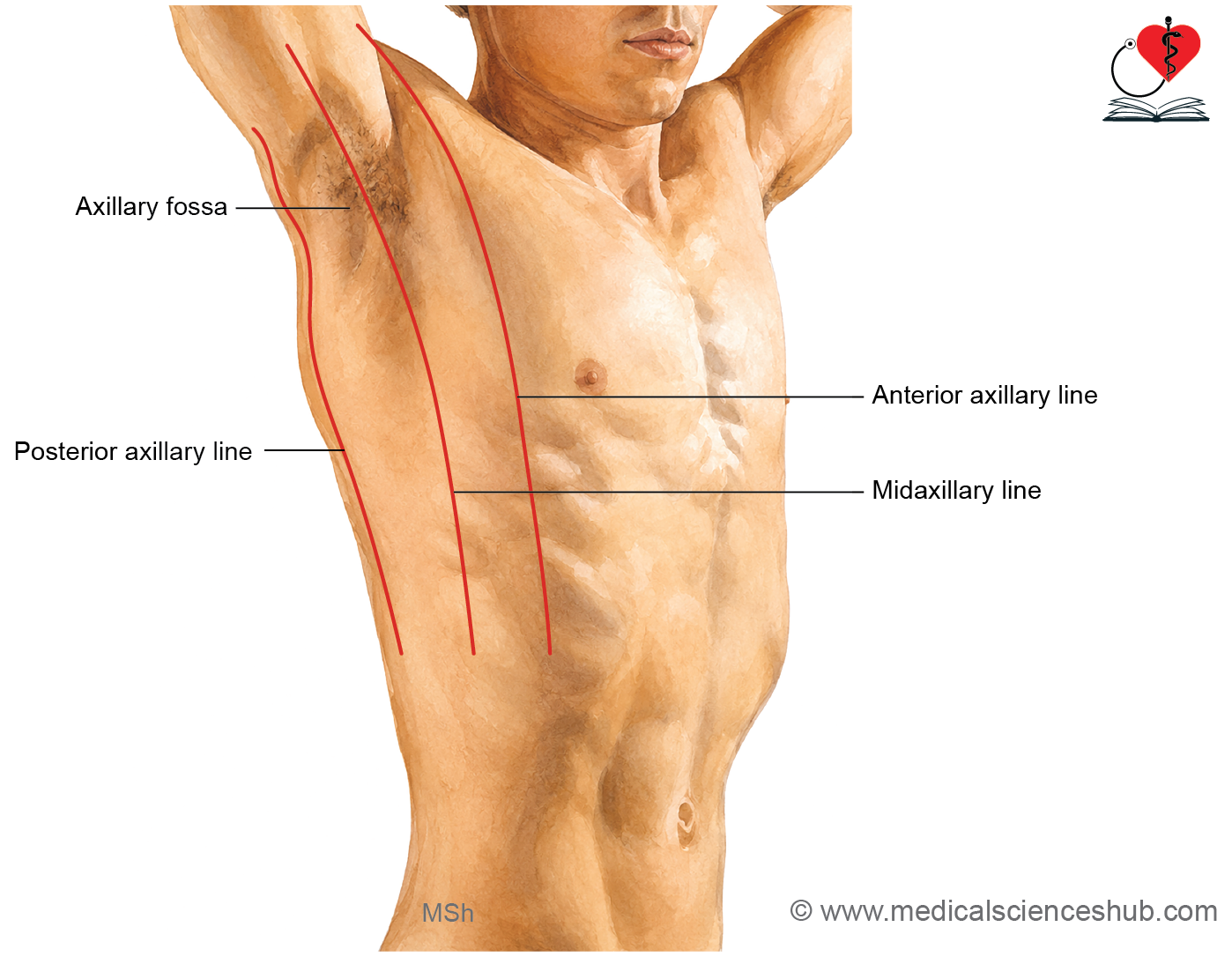
- The anterior axillary line follows the anterior axillary fold.
- The posterior axillary line follows the posterior axillary fold.
- The midaxillary line is located midway between the anterior and posterior axillary folds and serves as an important clinical landmark.
Contents of Superficial Fascia
- The superficial fascia of the pectoral region is composed of several important anatomical structures.
- It contains fat, which provides cushioning, thermal insulation, and energy storage.
- Loose connective tissue is present and allows mobility of the skin over the underlying structures.
- Cutaneous nerves travel within the superficial fascia and provide sensory innervation to the skin.
- Cutaneous blood vessels are located in this layer and supply oxygenated blood and nutrients to the skin and superficial tissues.
- The platysma muscle is present within the superficial fascia of the upper thoracic region and extends into the neck.
- The breast (mammary gland) is embedded within the superficial fascia of the anterior thoracic wall.
H4: Cutaneous Nerves of Pectoral Region
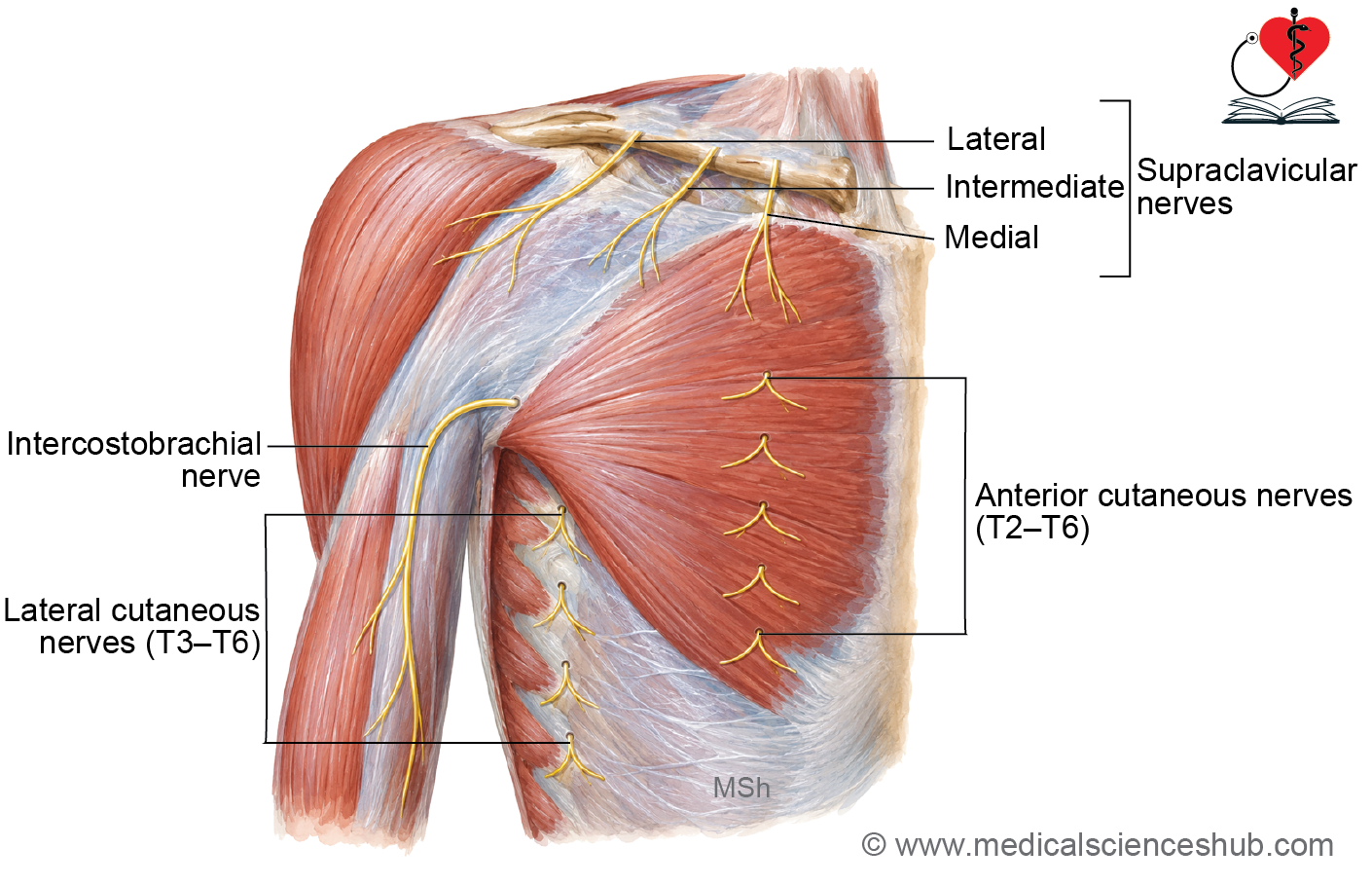
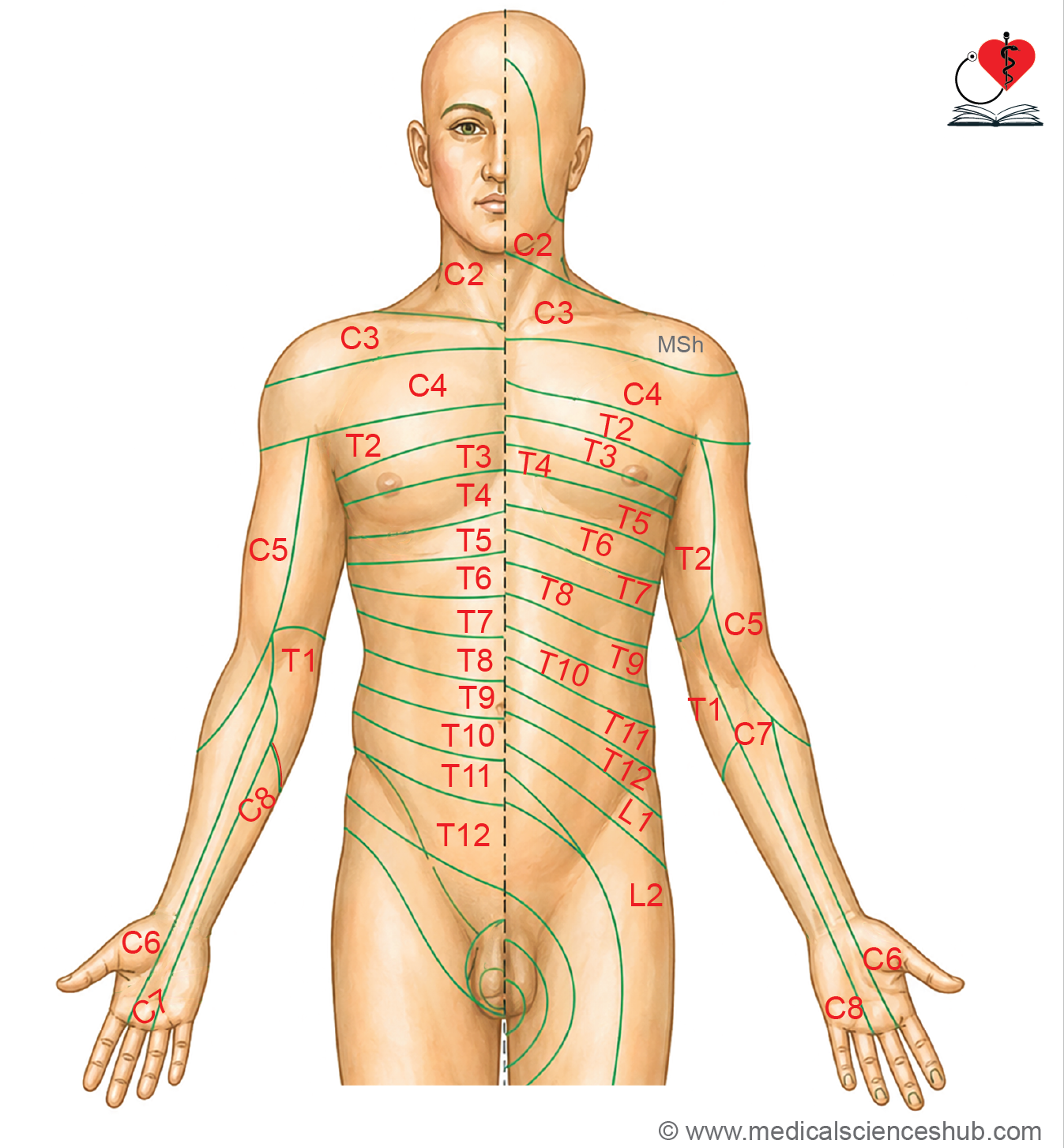
- The skin of the pectoral region receives sensory innervation from the supraclavicular nerves and the intercostal nerves.
- The supraclavicular nerves include the medial, intermediate, and lateral branches, which arise from the third and fourth cervical spinal nerves.
- These nerves supply the skin located above a horizontal line passing through the sternal angle.
- Therefore, the cutaneous innervation of the upper part of the pectoral region has the root values C3 and C4.
- The intercostal nerves contribute through their anterior and lateral cutaneous branches from the second to the sixth intercostal nerves.
- These branches supply the skin below the horizontal line passing through the sternal angle.
- The cutaneous innervation of the lower part of the pectoral region has the root values T2 to T6.
Cutaneous Blood Vessels of Pectoral Region
- The cutaneous blood vessels of the pectoral region provide the arterial supply to the skin and superficial tissues of the anterior chest wall.
- The perforating branches of the internal thoracic artery supply the skin and superficial tissues over the anterior aspect of the pectoral region.
- The lateral cutaneous branches of the posterior intercostal arteries accompany the lateral cutaneous branches of the intercostal nerves.
- These arteries supply the skin covering the lateral aspect of the thoracic wall.
- The supraclavicular artery, a branch of the transverse cervical artery, supplies the skin over the lateral end of the clavicle and the adjacent supraclavicular region.
- These vessels form an important vascular network that maintains adequate blood supply to the skin of the pectoral region.
Deep Fascia
- The deep fascia of the pectoral region is known as the pectoral fascia.
- It is a strong fibrous layer that encloses the pectoral muscles and provides structural support to the anterior thoracic wall.
Extension:
- Superiorly, the pectoral fascia is attached to the clavicle.
- Medially, it is firmly attached to the sternum.
- Superolaterally, it continues over the deltoid muscle as the deep fascia of the shoulder region.
- Inferolaterally, the fascia extends into the axilla, where it becomes the axillary fascia.
- Inferiorly, the pectoral fascia continues as the deep fascia covering the lower part of the thoracic wall.
Muscles Of Pectoral Region
Pectoral region has three muscles:
1. Pectoralis major
2. Pectoralis minor
3. Subclavius
Pectoralis Major
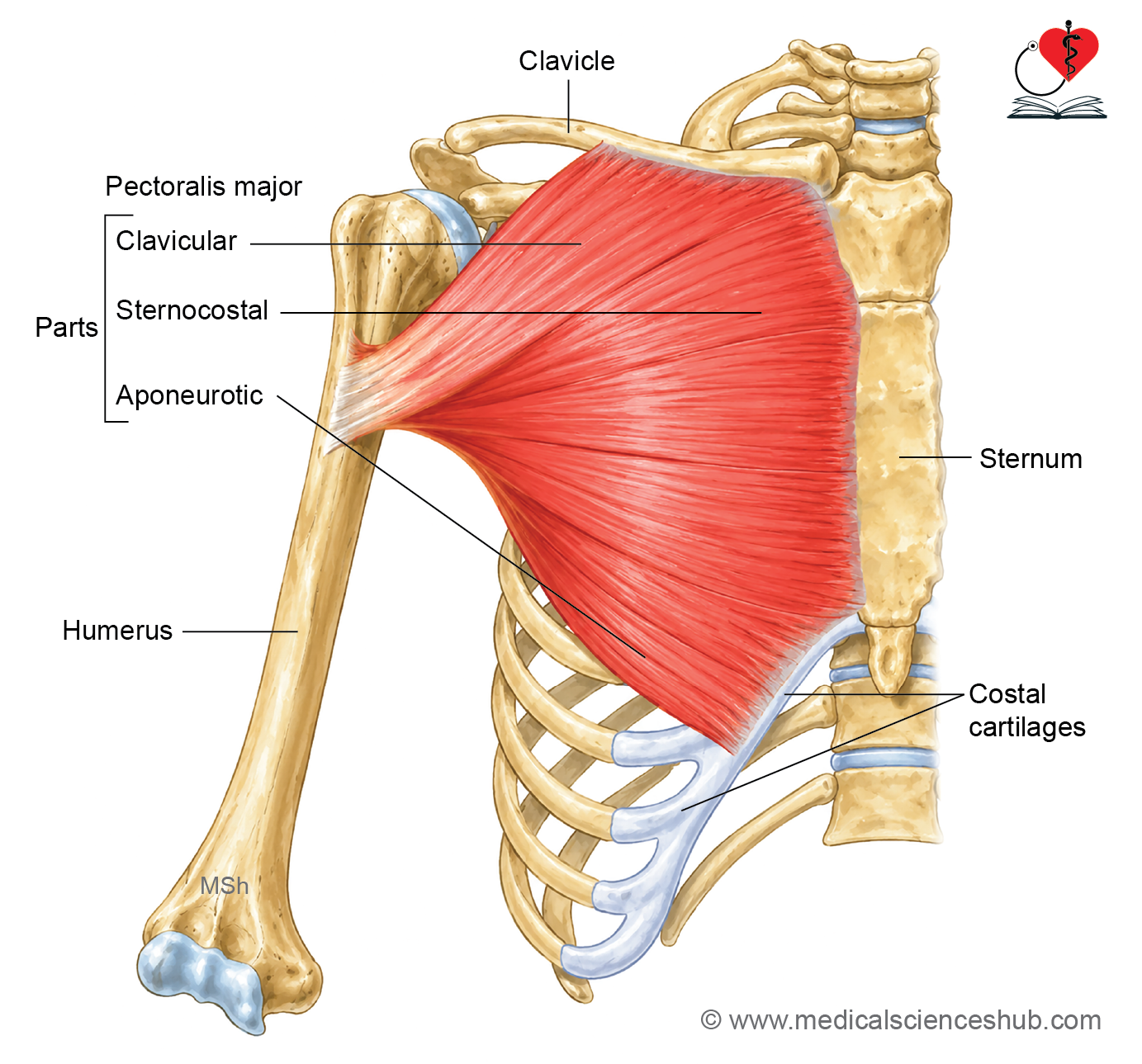
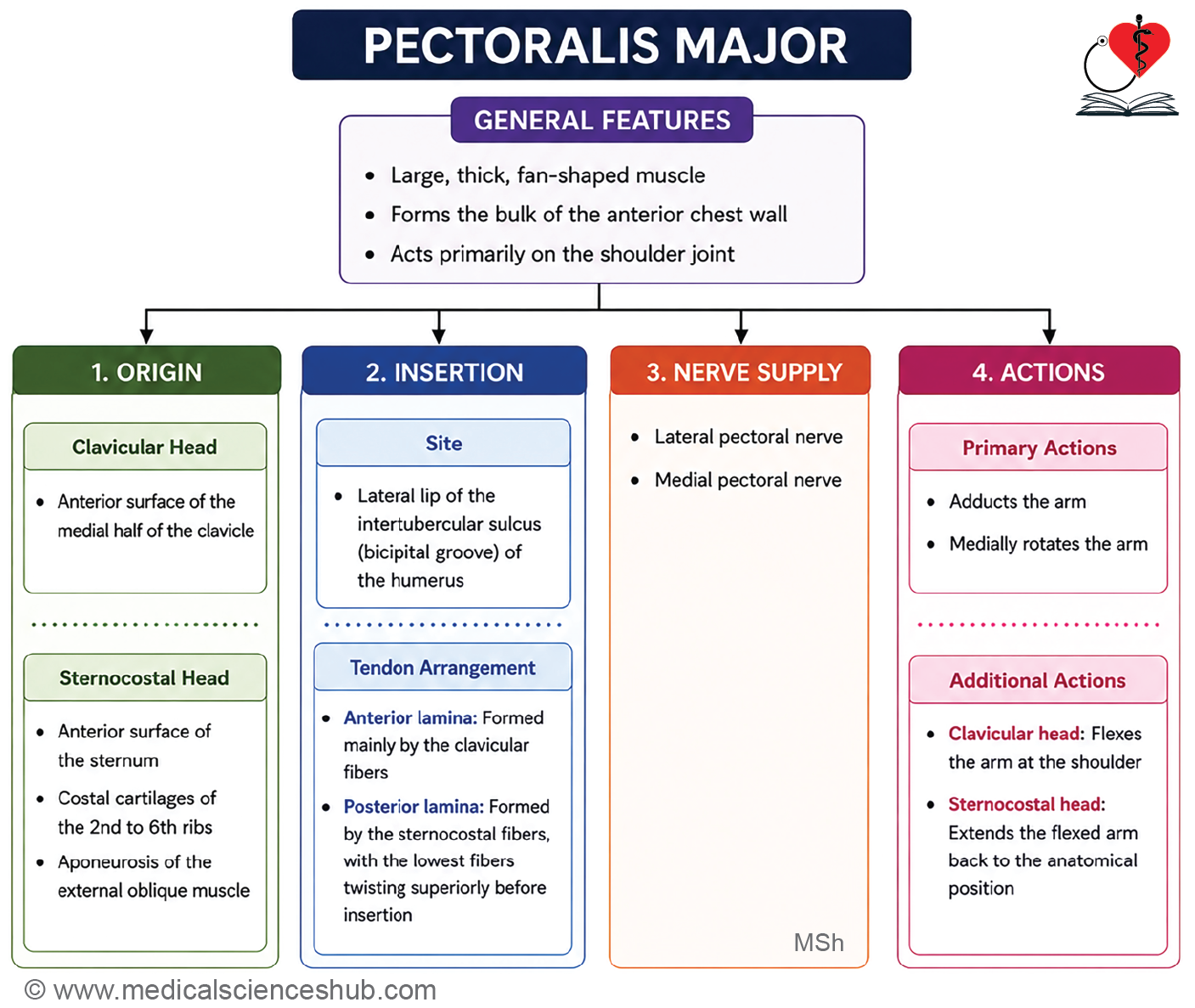
- The pectoralis major is the largest muscle of the pectoral region and forms the prominent muscular mass of the anterior chest wall.
- It is a thick, fan-shaped muscle located superficial to the thoracic cage.
Origin (proximal attachment)
- The pectoralis major has two heads of proximal attachment: the clavicular head and the sternocostal head.
- The clavicular head is the smaller of the two heads.
- It arises from the anterior surface of the medial half of the clavicle.
- The sternocostal head consists of manubrial, sternal, costal, and aponeurotic fibers.
- The manubrial fibers arise from the lateral part of the anterior surface of the manubrium.
- The sternal fibers originate from the lateral part of the anterior surface of the body of the sternum, extending to the level of the sixth costal cartilage.
- The costal fibers arise from the second to the sixth costal cartilages.
- The aponeurotic fibers originate from the aponeurosis of the external oblique muscle of the anterior abdominal wall.
- The external oblique muscle is the most superficial flat muscle of the anterolateral abdominal wall and ends in a broad, flat tendon called an aponeurosis.
Insertion (distal attachment)
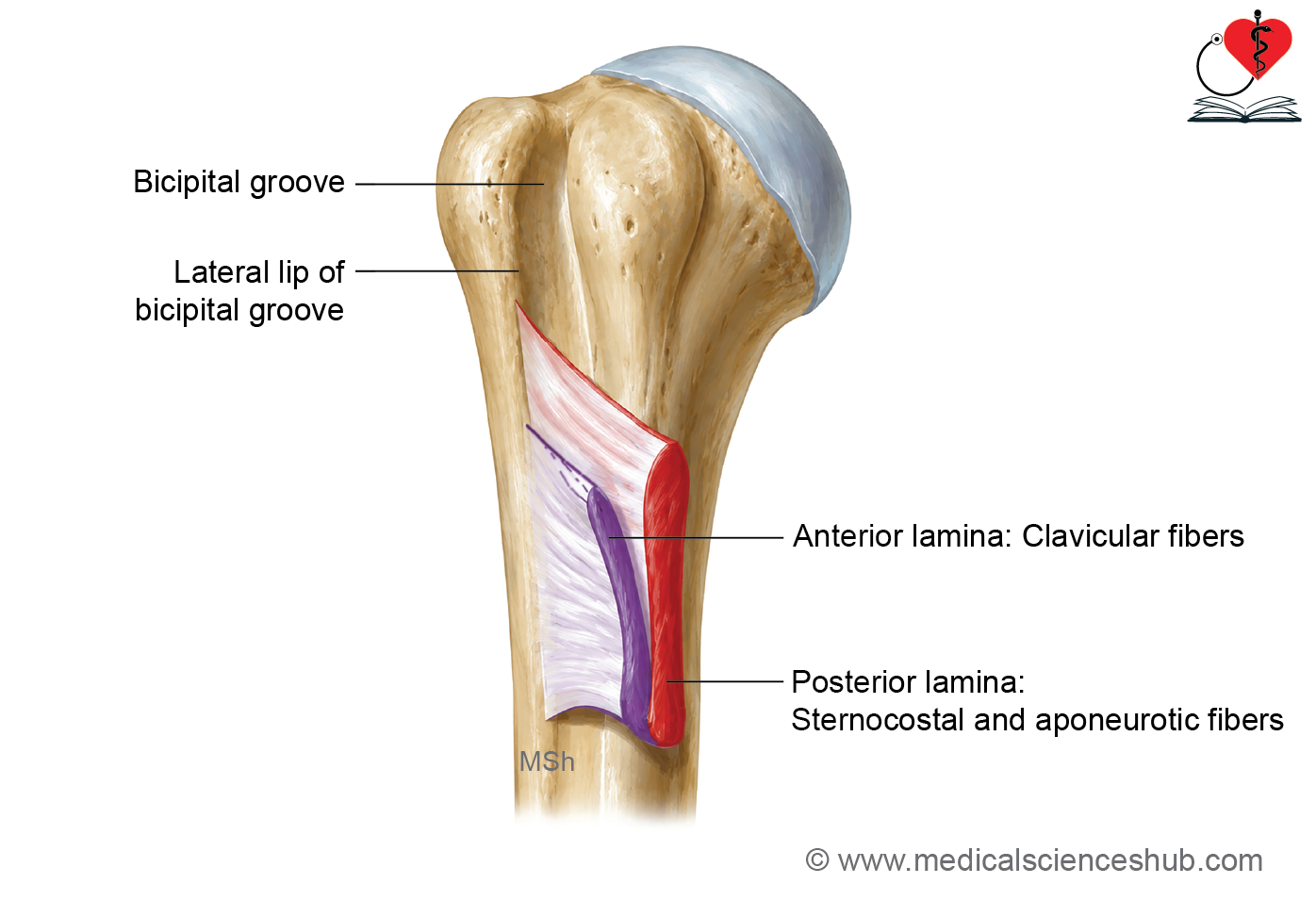
- The distal attachment of the pectoralis major is through a strong U-shaped bilaminar tendon.
- This tendon is inserted into the lateral lip of the intertubercular groove of the humerus.
- The bilaminar tendon consists of two distinct layers.
- The anterior lamina is shorter and is formed mainly by the clavicular fibers.
- The posterior lamina is formed predominantly by the sternocostal fibers.
- The arrangement of these tendon layers contributes to the strength and wide range of movements produced by the pectoralis major muscle.
Direction of fibers
- The clavicular fibers of the pectoralis major run downward and laterally.
- The sternocostal fibers run upward and laterally toward their insertion.
- The muscle fibers twist around the inferior border, causing the lowest fibers to insert at a higher level on the humerus.
- The anterior axillary fold is formed by the lateral border of the pectoralis major, particularly by its twisted lower fibers.
Innervation (nerve supply)
- Pectoralis major is supplied by medial and lateral pectoral nerves.
Actions
- The pectoralis major adducts and medially rotates the arm at the shoulder joint.
- It assists the serratus anterior in drawing the scapula forward.
- The clavicular head flexes the arm.
- The sternocostal head extends a previously flexed arm, particularly when movement occurs against resistance.
Clinical testing
- The clavicular head of the pectoralis major is tested by asking the individual to lift a heavy rod against resistance, making this part of the muscle prominent.
- The sternocostal head is tested by asking the individual to depress a fixed rod against resistance, which makes the sternocostal fibers more prominent during examination.
CLINICAL INTEGRATION
- The pectoralis major is the muscle most commonly affected by congenital absence.
- The congenital defect may involve complete or partial absence of the entire muscle or may affect only the clavicular head or the sternocostal head.
- In some individuals, a distinct cleft may be present between the clavicular and sternocostal heads of the pectoralis major.
Pectoralis Minor
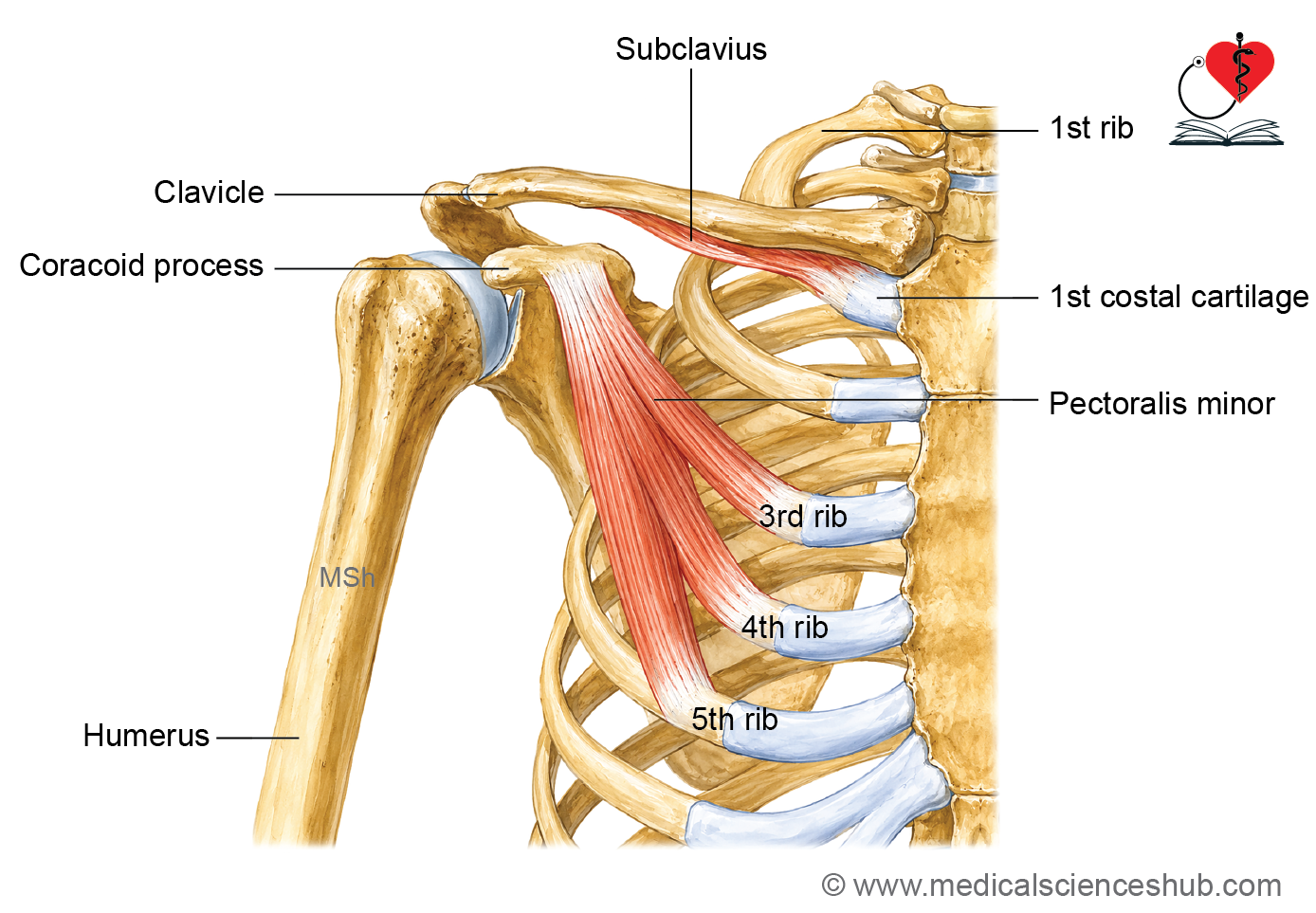
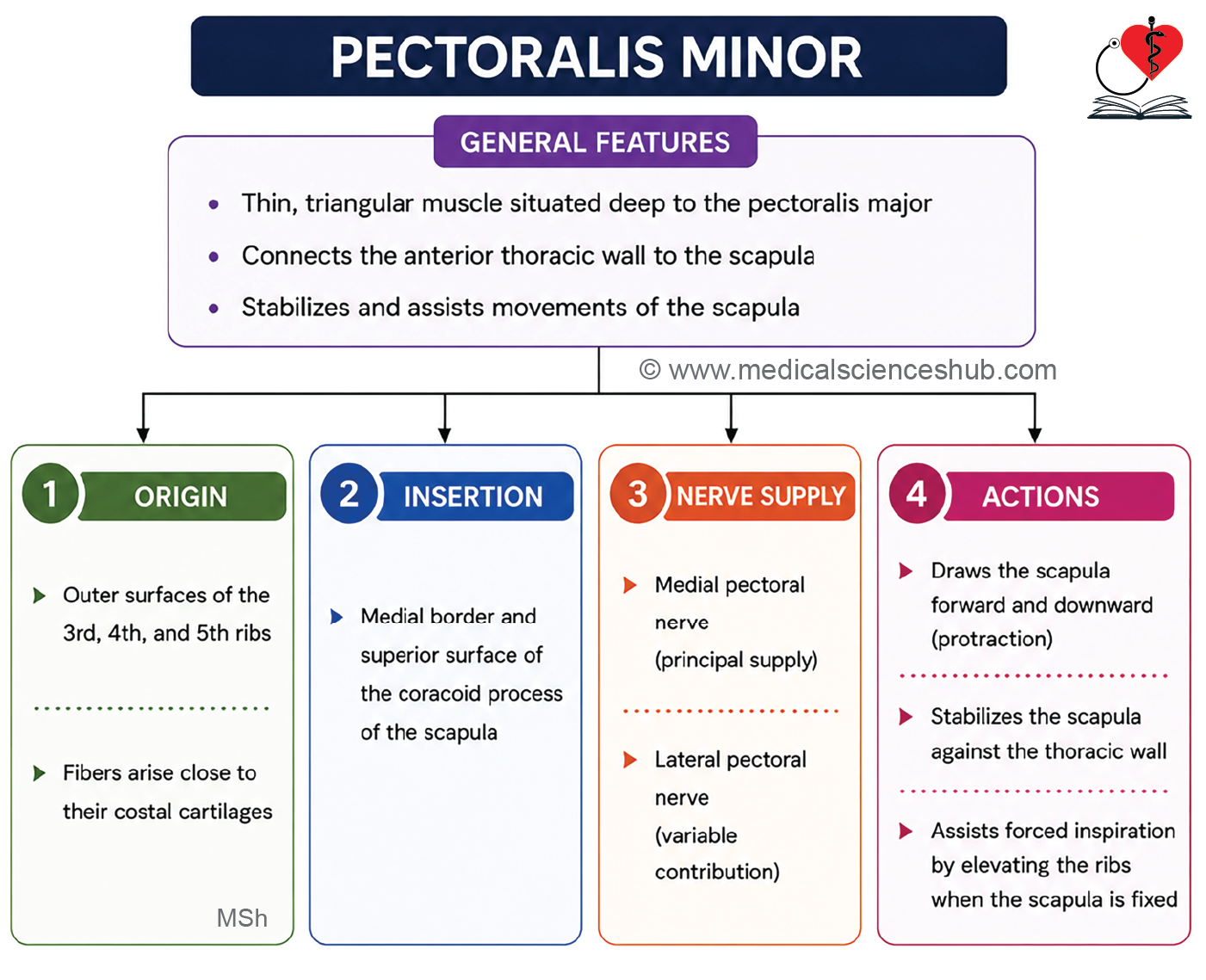
- The pectoralis minor is a thin, flat, triangular muscle located deep to the pectoralis major.
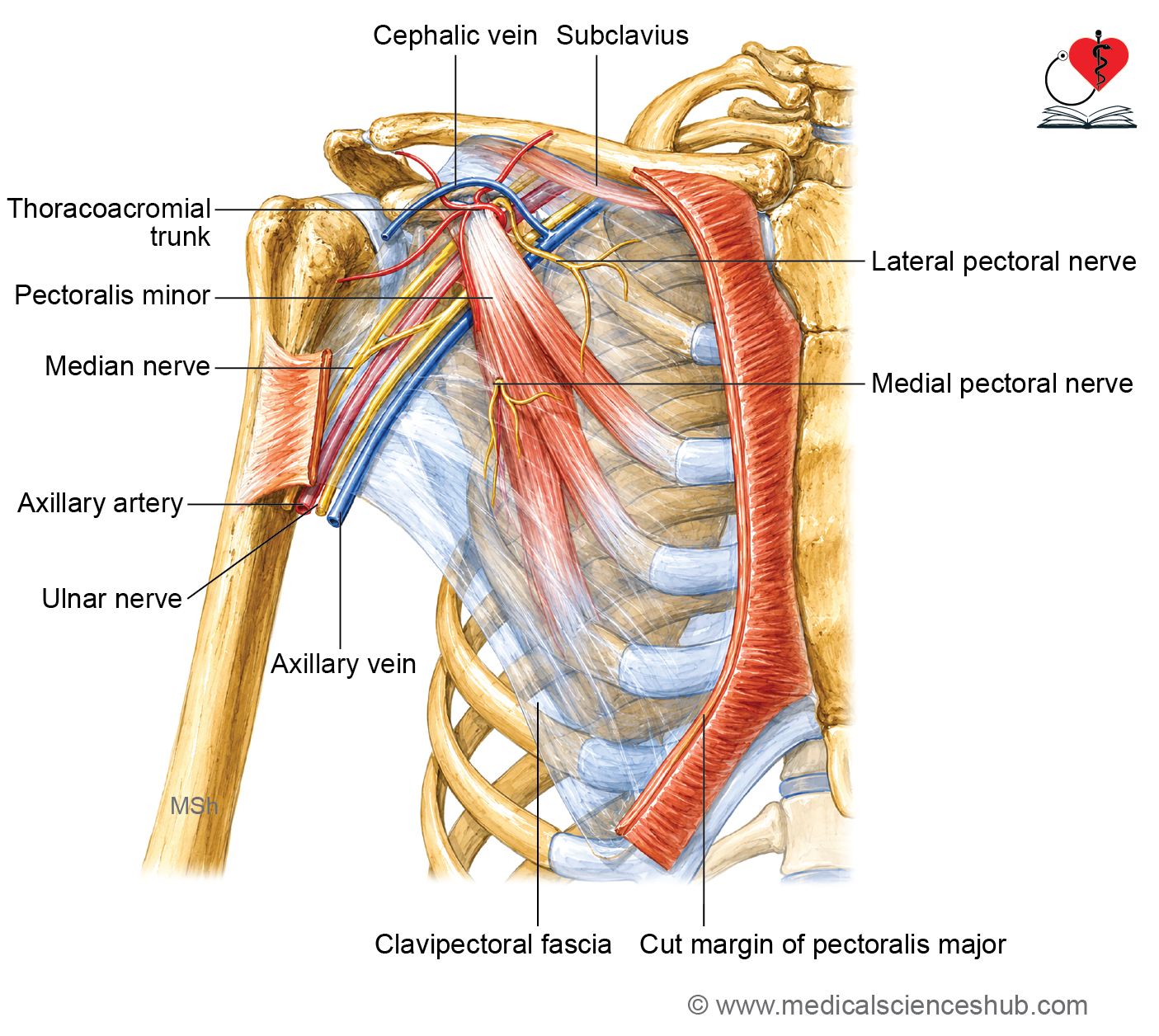
- It is enclosed within the clavipectoral fascia.
Origin
- The muscle usually originates from the third, fourth, and fifth ribs near their costal cartilages.
- It also arises from the fascia covering the external intercostal muscles.
Direction of Muscle Fibers
- Its fibers pass upward and laterally, converging to form a short, flat tendon.
Insertion
- The tendon inserts onto the medial border and superior surface of the coracoid process of the scapula.
Innervations (nerve supply)
- The muscle receives motor innervation from the medial and lateral pectoral nerves.
Actions
- The pectoralis minor draws the scapula forward together with the serratus anterior muscle and assists in the punching movement.
- It also depresses the shoulder by pulling the scapula inferiorly.
- During forced inspiration, it functions as an accessory muscle of respiration when the scapula is fixed.
CLINICAL INTEGRATION
- The origin of the pectoralis minor is variable.
- In a prefixed pattern, it arises from the second to fifth ribs.
- In a postfixed pattern, it arises from the third to sixth ribs.
- Poland syndrome is a rare congenital condition characterized by underdevelopment of the muscles on one side of the chest and upper limb. It is believed to result from reduced blood supply to the developing tissues during embryonic life. The condition occurs in approximately 1 in 20,000 live births.
- The pectoralis minimus is an accessory muscle that may occasionally be present in the pectoral region. It typically originates from the first costal cartilage and inserts onto the coracoid process of the scapula. This accessory muscle lies deep to the pectoralis major muscle.
Subclavius
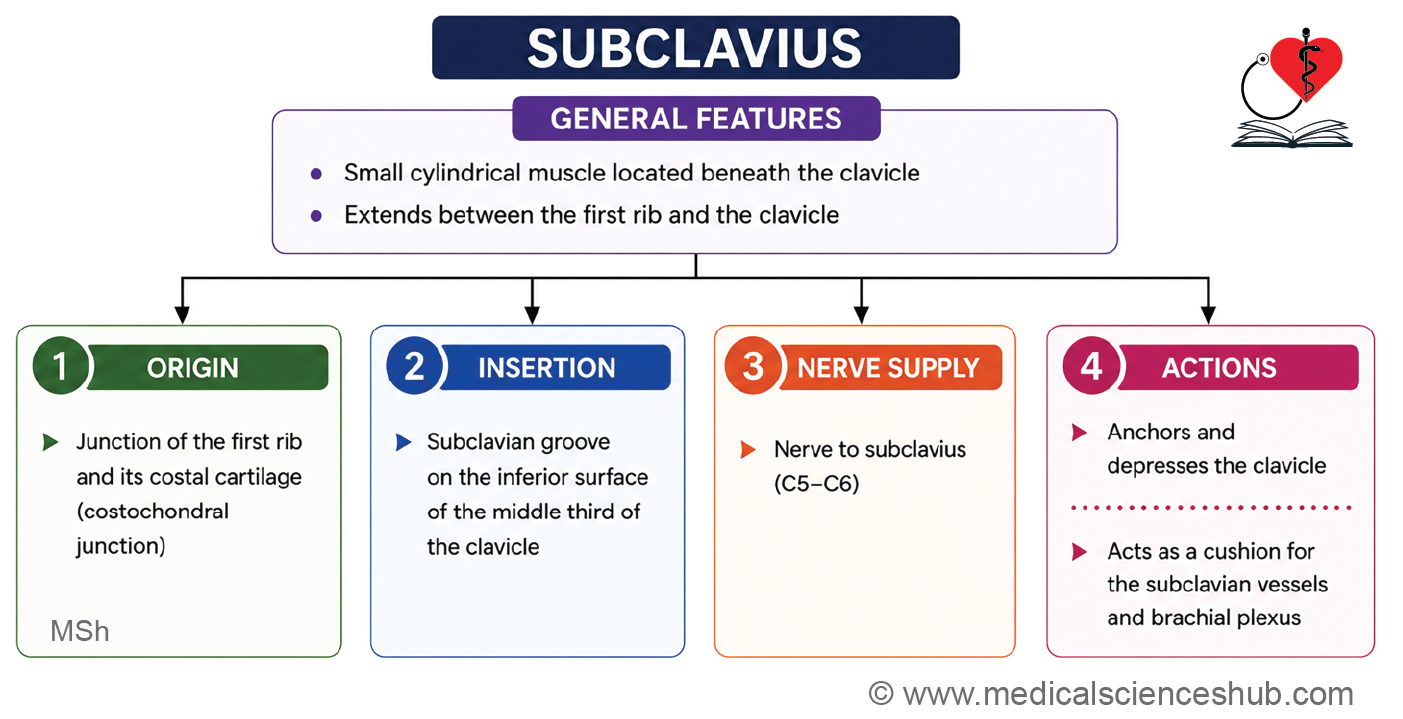
- The subclavius is a small triangular muscle located horizontally beneath the clavicle.
- It lies within the clavipectoral fascia and is exposed by reflecting the clavicular head of the pectoralis major and removing the overlying fascia.
Origin
- The muscle originates from the first rib at the costochondral junction.
Direction
- Its fibers pass superolaterally toward the inferior surface of the clavicle.
Insertion
- It inserts into the subclavian groove on the inferior surface of the middle one-third of the clavicle.
Innervations (nerve supply)
- The muscle is supplied by the nerve to subclavius, a branch of the upper trunk of the brachial plexus, with root values C5 and C6.
Actions
- The subclavius helps protect the brachial plexus and subclavian vessels by acting as a muscular cushion.
- It also stabilizes the clavicle during movements of the shoulder girdle.
Clavipectoral fascia
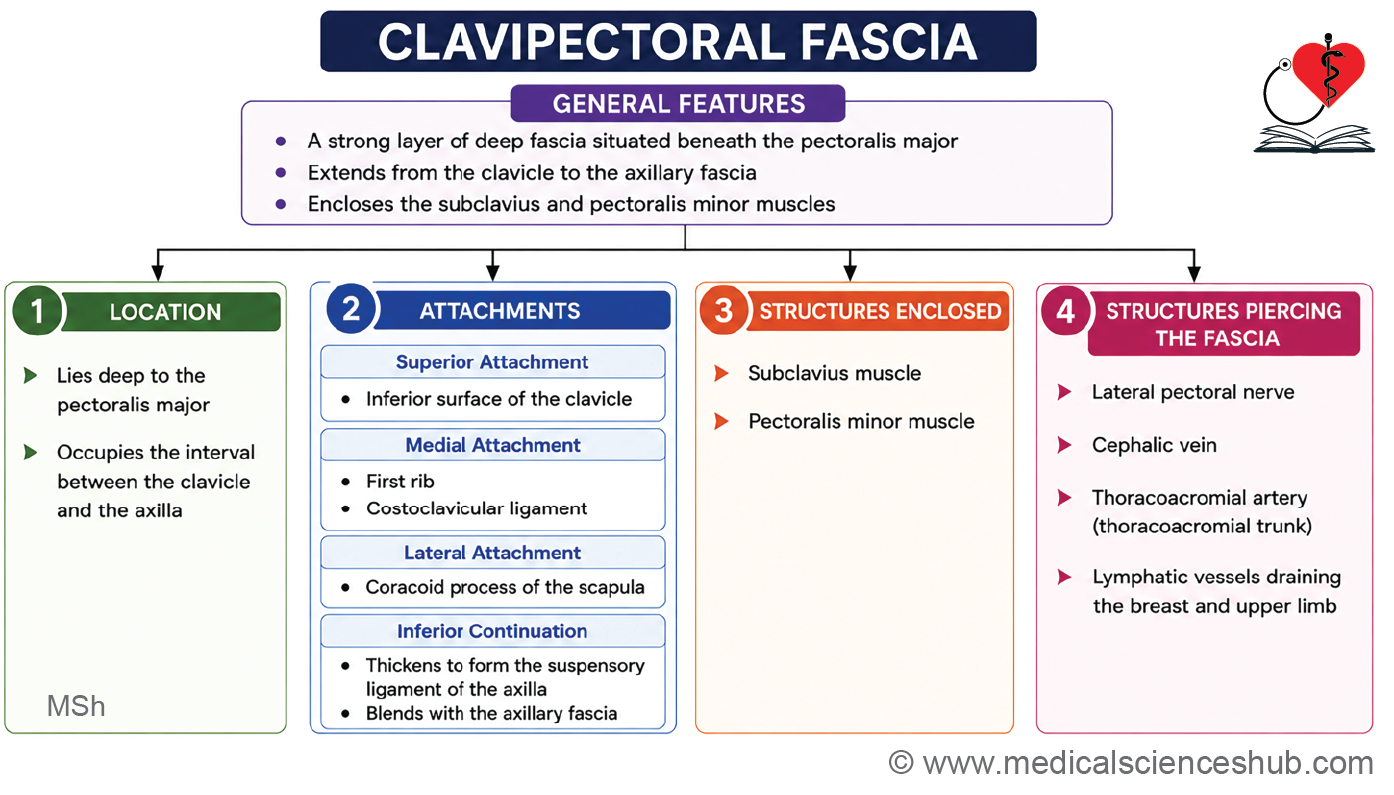
The clavipectoral fascia, also called the costocoracoid membrane, is a part of the deep fascia located deep to the pectoralis major muscle.
Extent
- Medially, it blends with the fascia covering the first and second intercostal spaces.
- Laterally, it is attached to the coracoid process of the scapula.
- Superiorly, the fascia splits into anterior and posterior laminae that enclose the subclavius muscle. The anterior lamina attaches to the anterior margin of the subclavian groove of the clavicle. The posterior lamina attaches to the posterior margin of the subclavian groove and continues with the investing layer of the deep cervical fascia.
- Inferiorly, the fascia encloses the pectoralis minor muscle.
- Below the pectoralis minor, it continues as the suspensory ligament of the axilla, which attaches to the axillary fascia and helps maintain the dome-shaped contour of the axilla by elevating the fascia.
- The costocoracoid ligament is the thickened part of the clavipectoral fascia extending from the first rib to the coracoid process.
Content
The clavipectoral fascia encloses the subclavius and pectoralis minor muscles.
Structures piercing clavipectoral fascia
The structures piercing this fascia include
- Lateral pectoral nerve
- Cephalic vein
- Thoracoacromial trunk
- Lymphatic vessels from breast to apical axillary group of lymph nodes.
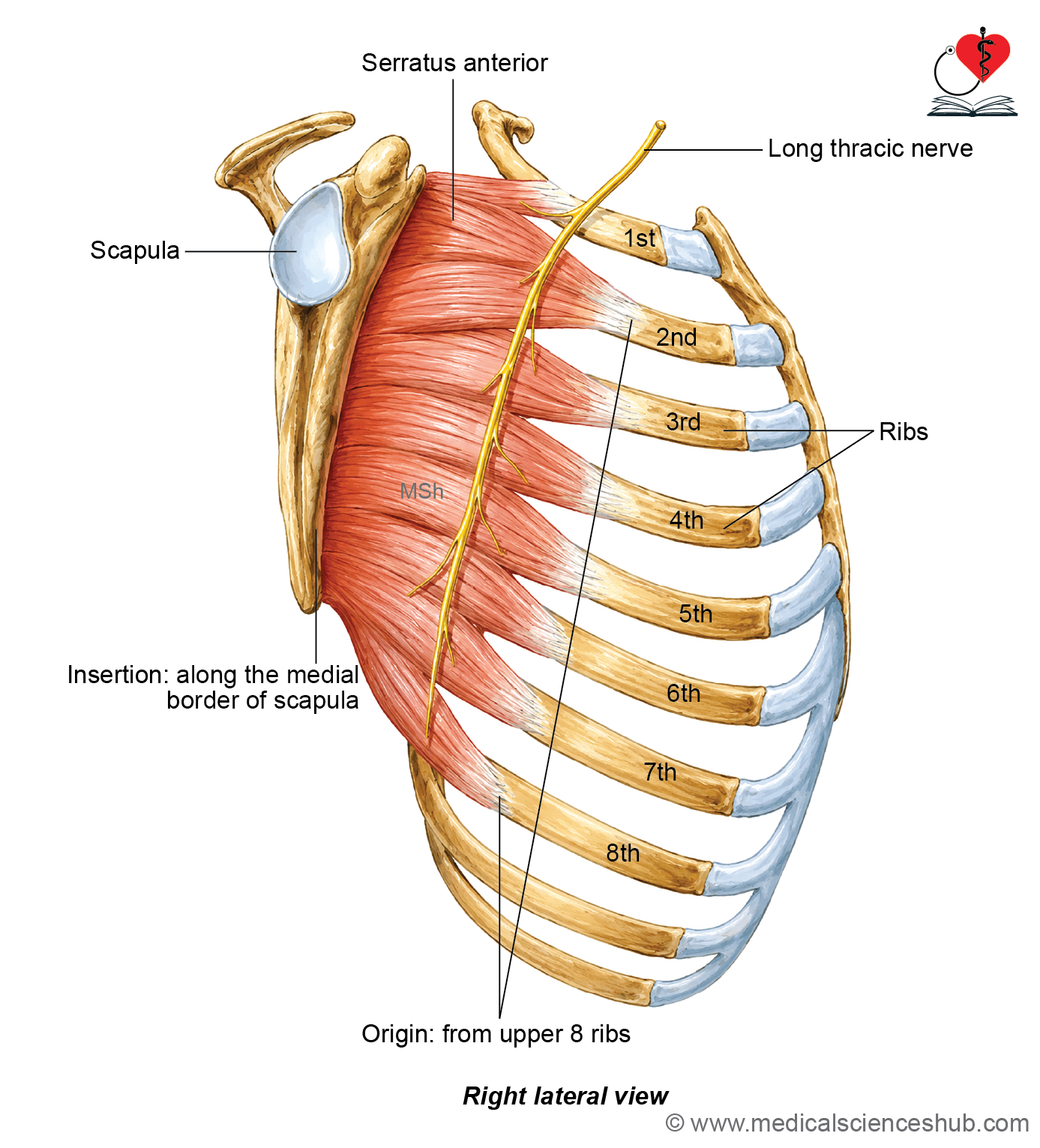
Serratus Anterior Muscle
- The serratus anterior is a broad, flat muscle located along the posterolateral wall of the thorax and is not considered a muscle of the pectoral region.
- It is also known as the boxer’s muscle because of its important role in upper limb movements.
Origin
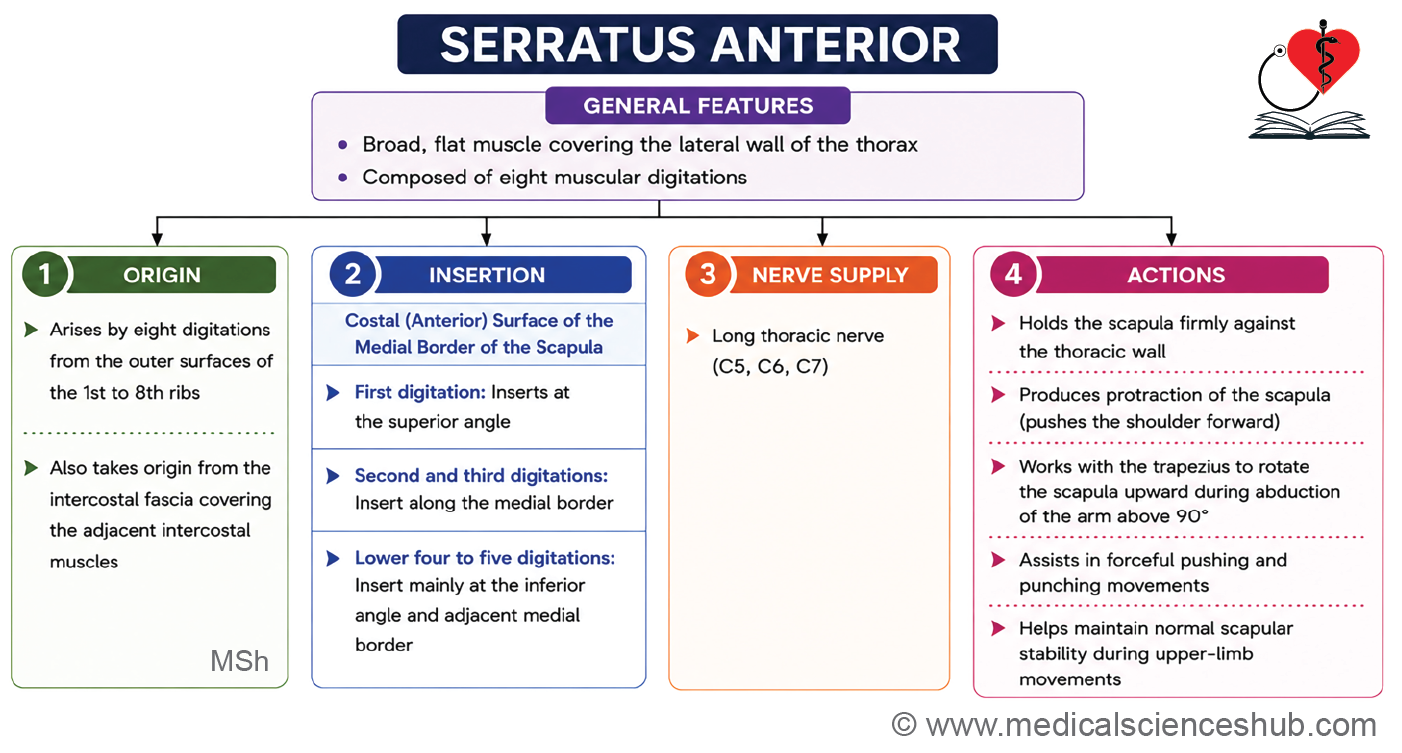
The muscle originates by eight digitations from the upper eight ribs and the fascia covering the intervening intercostal muscles in the midaxillary plane.
Direction
ts fibers pass posteriorly around the thoracic wall to reach the medial border of the scapula.
Insertions
- The first digitation inserts at the superior angle of the scapula.
- The second and third digitations attach along the medial border of the scapula.
- The remaining digitations insert into the triangular area on the costal surface of the inferior angle of the scapula.
Innervation (nerve supply)
- The muscle is supplied by the long thoracic nerve, which arises from the C5, C6, and C7 roots of the brachial plexus.
- The long thoracic nerve runs on the superficial surface of the serratus anterior muscle in the midaxillary line.
Actions
- The serratus anterior works with the pectoralis minor to pull the scapula forward during pushing and punching movements.
- Its lower four or five digitations act with the lower fibers of the trapezius muscle to rotate the scapula upward, enabling overhead abduction of the arm.
- The muscle stabilizes the scapula by keeping its medial border firmly applied against the thoracic wall.
Clinical testing
The serratus anterior muscle is clinically tested by asking the patient to push against a wall with both hands.
Clinical anatomy
Winging of scapula
- Injury to the long thoracic nerve results in paralysis of the serratus anterior muscle.
- When an affected individual pushes against a fixed wall, the medial border of the scapula protrudes prominently from the posterior thoracic wall.
- This clinical deformity is known as winging of the scapula.
- Paralysis of the serratus anterior impairs the ability to perform pushing and punching movements.
- It also prevents effective upward rotation of the scapula, resulting in an inability to fully abduct the arm above the horizontal level.
Important Questions
- Write a short note on pectoralis major.
- Write a short note on pectoralis minor.
- List the structures piercing clavipectoral fascia.
- Write a short note on clavipectoral fascia.
- Write a short note on serratus anterior muscle.
📝 Test Your Knowledge – Practice MCQs
Attempt the chapter MCQ quiz and assess your understanding of key concepts.
Click to see: Medical Disclaimer and Copyright Notice