📝 Practice MCQs

Click to see: Medical Disclaimer and Copyright Notice
🎙️ Frequently Asked Viva Questions
Q1. Why is the elbow classified as a compound synovial hinge joint rather than a simple hinge joint?
Answer: Three bones (humerus, radius, and ulna) participate in a common synovial cavity while permitting mainly flexion and extension.
Q2. Why does the synovial cavity of the elbow communicate with the superior radioulnar joint?
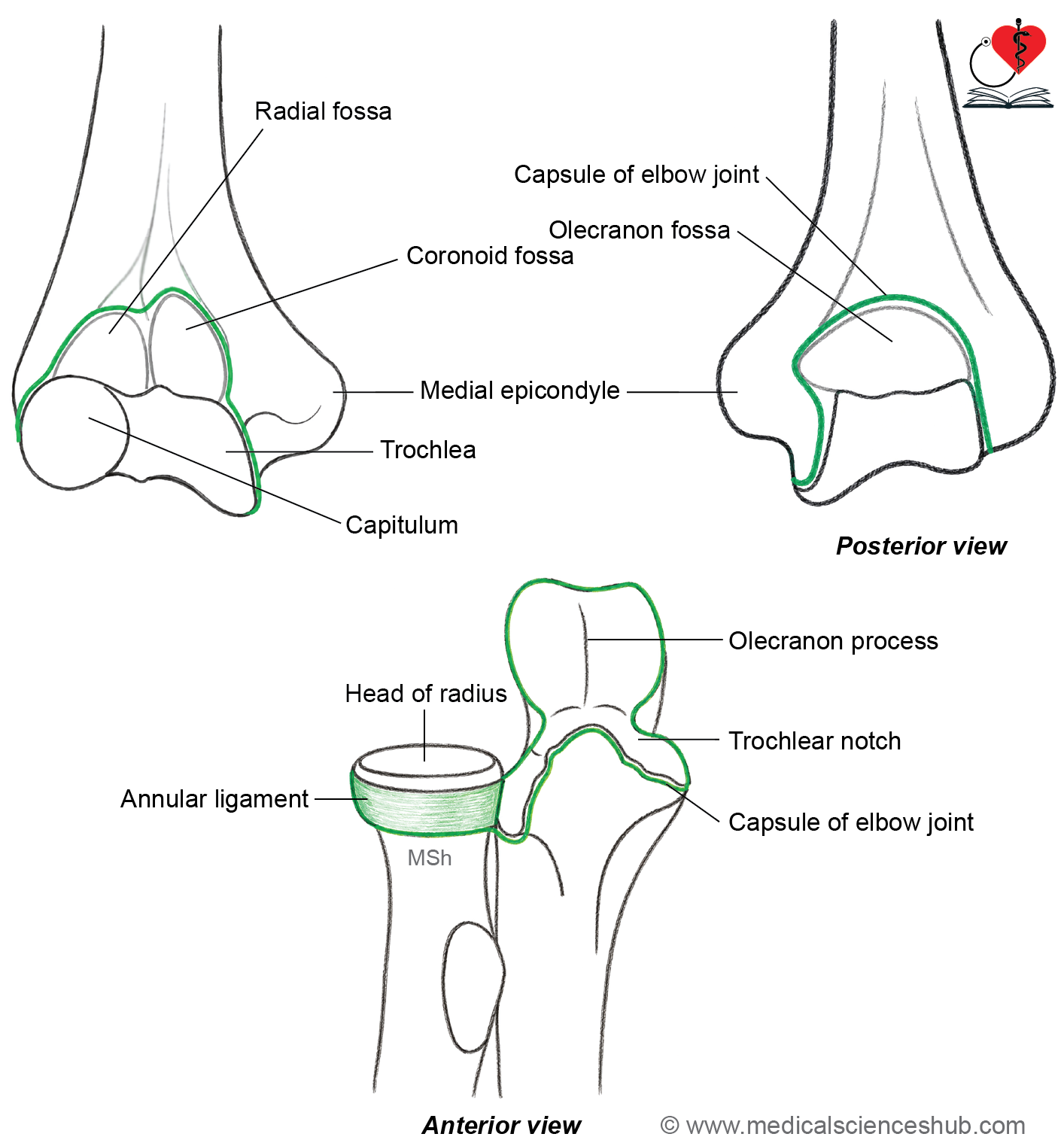
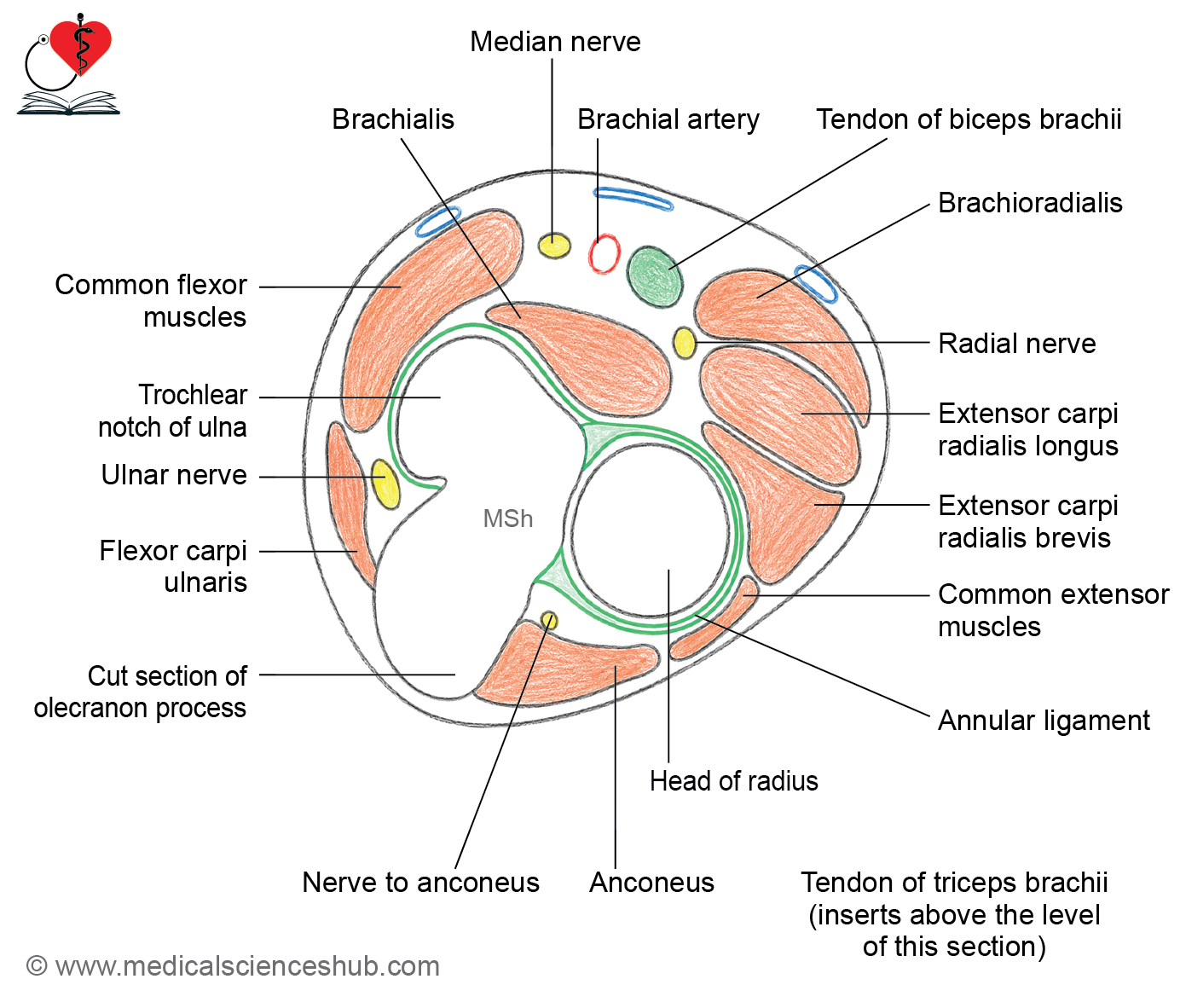
Answer: The synovial membrane extends beneath the annular ligament to the neck of the radius, creating a continuous synovial cavity.
Q3. Why is the anterior band of the ulnar collateral ligament the most important stabilizer of the elbow?
Answer: It is the strongest component of the ligament and provides the principal resistance to valgus stress.
Q4. What is the anatomical basis of the carrying angle?
Answer: The medial flange of the trochlea projects farther distally, and the oblique trochlear axis produces physiological lateral deviation of the forearm.
Q5. Why does the carrying angle disappear during elbow flexion and forearm pronation?
Answer: The obliquity of the trochlea is neutralized during flexion and pronation, aligning the arm and forearm.
Q6. Why is posterior dislocation the most common type of elbow dislocation?
Answer: Posterior displacement occurs more readily, whereas anterior dislocation is prevented by the olecranon, strong capsule, and collateral ligaments.
Q7. Why is aspiration of the elbow joint performed from the lateral side?
Answer: The lateral triangular interval provides safe access to the joint while minimizing injury to major neurovascular structures.
Q8. Why is the annular ligament essential for normal forearm movements?
Answer: It securely holds the radial head against the radial notch while allowing free rotation during pronation and supination.
Q9. Why does the superior radioulnar joint function as a pivot joint?
Answer: The head of the radius rotates within the fibro-osseous ring formed by the annular ligament and radial notch of the ulna.
Q10. Why do the fibres of the interosseous membrane run downward and medially?
Answer: This orientation efficiently transmits compressive forces from the radius to the ulna during weight-bearing through the hand.
Q11. Why is the oblique cord considered a vestigial structure?
Answer: It is regarded as a degenerated remnant of the flexor pollicis longus muscle.
Q12. Why is supination generally more powerful than pronation?
Answer: The biceps brachii is a powerful supinator, especially with the elbow flexed, providing greater torque than the pronator muscles.
Q13. Why is the wrist classified as a compound condyloid joint but not a complex synovial joint?
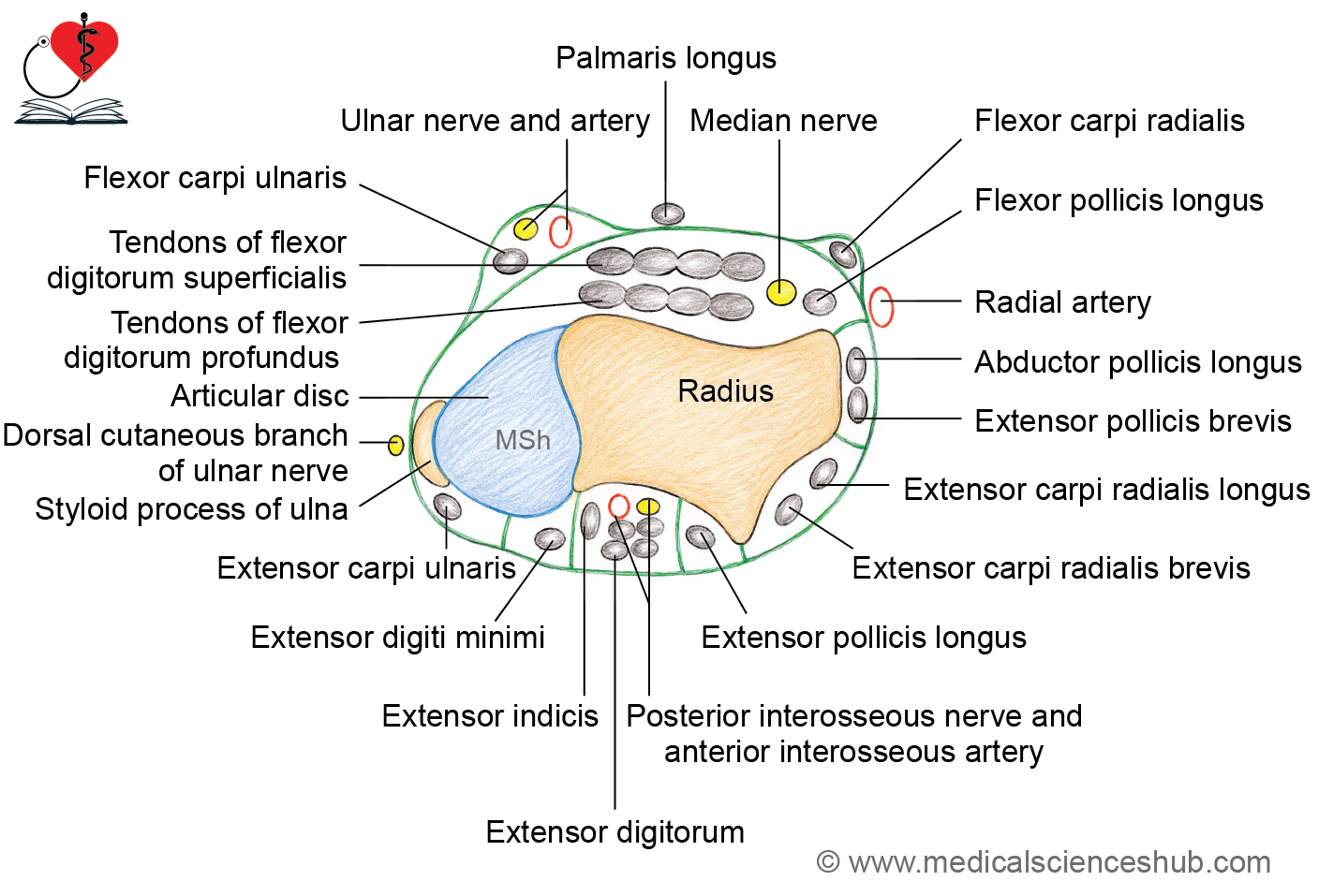
Answer: Although an articular disc is present, it lies proximal to the wrist cavity and separates the distal radioulnar joint from the wrist joint.
Q14. Why is the wrist immobilized in about 30° dorsiflexion after injury?
Answer: This functional position optimizes ligament tension, preserves hand function, and minimizes post-immobilization stiffness.
Hand Drawn Diagrams