
Competencies
- PY1.8: Describe and discuss the molecular basis of resting membrane potential and action potential in excitable tissue
Introduction
- Every living cell maintains a tiny electrical difference across its membrane that is essential for nerve conduction, muscle activity, and cellular communication. This membrane potential mainly depends on potassium ion movement, selective membrane permeability, and the continuous action of the sodium–potassium pump.
Resting Membrane Potential
- All living cells exhibit a membrane potential, with the interior negative relative to the exterior.
- This potential arises from unequal distribution of ions across the cell membrane.
- At rest, it is called the resting membrane potential.
- The value varies among different tissues.
- In neurons, it is approximately −70 millivolts.
- Stimulation causes depolarization, producing an action potential.
- Resting membrane potential determines the initiation and duration of action potentials.
- In some tissues, such as smooth muscle, it may fluctuate.
Table 7.1: RMP of important excitable tissues.
| Tissue/Cell | RMP (mV) |
|---|---|
| Neuron | –70 |
| Skeletal muscle | –90 |
| Cardiac muscle | –90 |
Concepts And Physiological Aspects
- Membrane potential arises from unequal ion distribution across the cell membrane. It depends on selective permeability of ions at rest.
- Ion distribution is influenced by electrochemical forces.
- Key concepts include Gibbs–Donnan equilibrium, Nernst equation, and Goldman–Hodgkin–Katz equation.
Selective Permeability of the Membrane
- The cell membrane shows selective permeability to ions and solutes.
- Permeability depends on ion size and hydrated radius.
- Potassium ions have much higher permeability than sodium ions.
- Chloride and bicarbonate ions are moderately permeable.
- Intracellular proteins and organic phosphates are impermeable.
- This selective ion movement contributes to membrane potential formation.
Table 7.2: Molecular weight and radius of hydrated ions and other substances.
| Ions/substances | Molecular weight | Radius |
|---|---|---|
| K+ | 39 | 0.12 |
| Cl– | 35.5 | 0.12 |
| H2O | 18 | 0.12 |
| Ca++ | 40 | 0.15 |
| Na+ | 23 | 0.18 |
| Urea | 60 | 0.23 |
| Glucose | 180 | 0.38 |
| Albumin | 69,000 | 7.50 |
Gibbs-Donnan Membrane Equilibrium
- Gibbs–Donnan equilibrium occurs across a semipermeable membrane separating ionic solutions.
- Each solution remains electrically neutral, with equal total cations and anions.
- Diffusible ions distribute so that their product is equal on both sides. This equilibrium influences ion distribution and membrane potential.
- At equilibrium, each compartment maintains electroneutrality, with equal total cations and anions.
- For example, sodium ion concentration equals chloride ion concentration within each compartment.
- The product of diffusible cation and anion concentrations remains equal on both sides of the membrane.
- This relationship determines the distribution of ions across the membrane.
- The ratio of cations between compartments is inversely related to the ratio of anions.
- These relationships explain unequal ion distribution in the presence of non-diffusible ions.
- They contribute to the development of membrane potential.
- At equilibrium, ions are evenly distributed while maintaining electroneutrality.
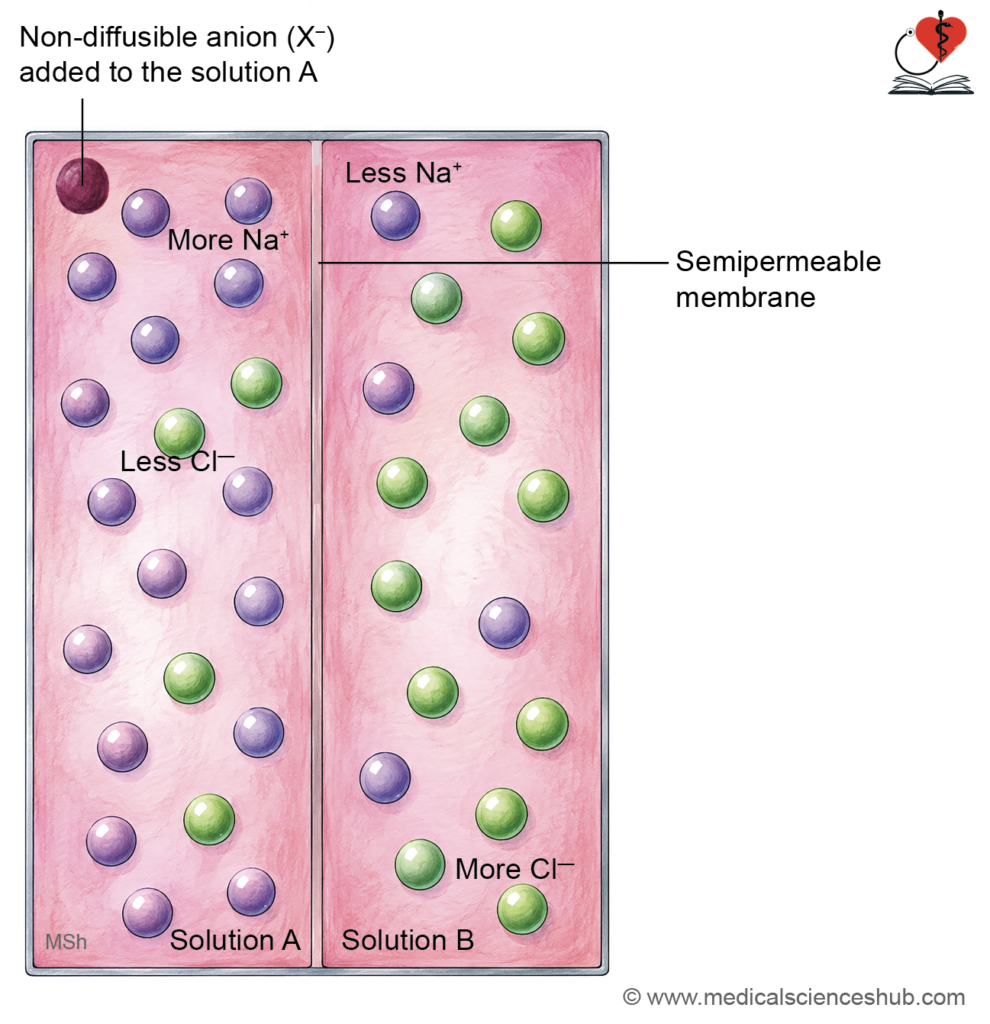
- Addition of a non-diffusible ion alters distribution of diffusible ions to preserve balance.
- Presence of non-diffusible anions causes unequal ion distribution across the membrane.
- Sodium concentration becomes higher on the side containing these anions.
- Chloride concentration increases on the opposite side. Similar distribution occurs between intracellular and extracellular fluids.
- Intracellular proteins create asymmetry, making the cell interior negatively charged.
Nernst Equation
- Nernst equation determines the equilibrium potential of an ion across a membrane. It describes balance between concentration gradient and electrical gradient.
- At equilibrium, ion movement in both directions is equal. It applies to individual ions such as potassium, sodium, or chloride.
- The equation depends on ion valency, temperature, and concentration inside and outside the cell.
- It calculates the potential difference required to prevent net ion diffusion.
- At body temperature, the equation can be simplified for practical use.
- This equation is essential for understanding membrane potential and ion distribution.
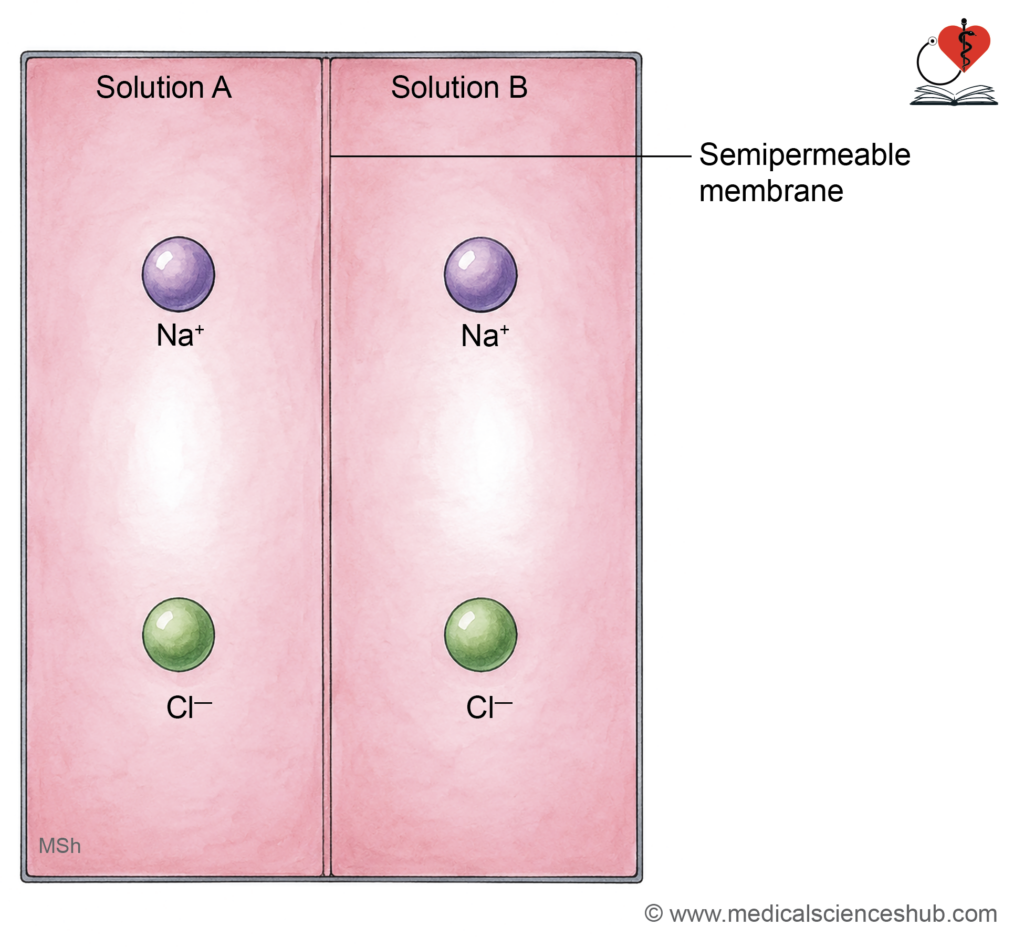
Table 7.3: Concentrations (mmol/L) of important ions in ECF and ICF and their equilibrium potential (EP) in a mammalian spinal motor neuron.
| Ions | ECF | ICF | EP (mV) |
|---|---|---|---|
| Na+ | 150 | 15 | +60 |
| K+ | 5.5 | 150 | –90 |
| Cl– | 125 | 9 | –70 |
| HCO3 | –21 | 5 | –25 |
| Calcium | 2.5 | 10–4 | +130 |
Goldman-Hodgkin-Katz Equation
The magnitude of the membrane potential at any given time depends on the distribution of Na+, K+ and Cl– and on the permeability of each of these ions. The role of different ions in the generation of membrane potential is accurately described by Goldman-Hodgkin-Katz (GHK) equation or also called Goldman’s constant field equation.
where,
- V : membrane potential,
- R : gas constant,
- T : absolute temperature,
- F : Faraday constant,
- ln : natural logarithm
- PK+, PNa+ and PCl─ : permeabilities of the membrane to K+, Na+ and Cl–, and i and o refer to inside and outside of the cell respectively
Importance of Goldman Constant Field Equation
- The Goldman–Hodgkin–Katz equation calculates membrane potential using multiple ions.
- It considers concentrations of sodium, potassium, and chloride ions.
- It also includes membrane permeability of each ion.
- The equation provides a more accurate value than single-ion calculations.
Importance
- Membrane potential depends on ion gradients and permeability.
- Potassium has the greatest influence due to higher permeability.
- Sodium and chloride also contribute to the final potential.
- Outward diffusion of cations leaves negative charge inside the cell.
Genesis Of Rmp
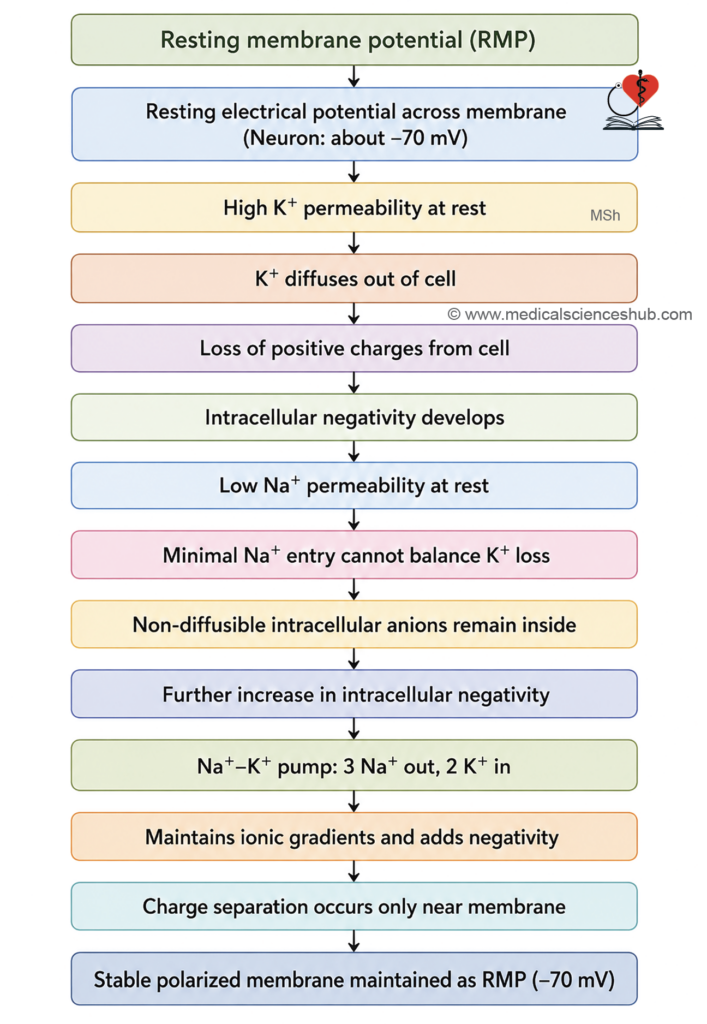
- Resting membrane potential is the electrical potential across the membrane in the resting state.
- In neurons, it is approximately −70 millivolts.
Role of Potassium Permeability
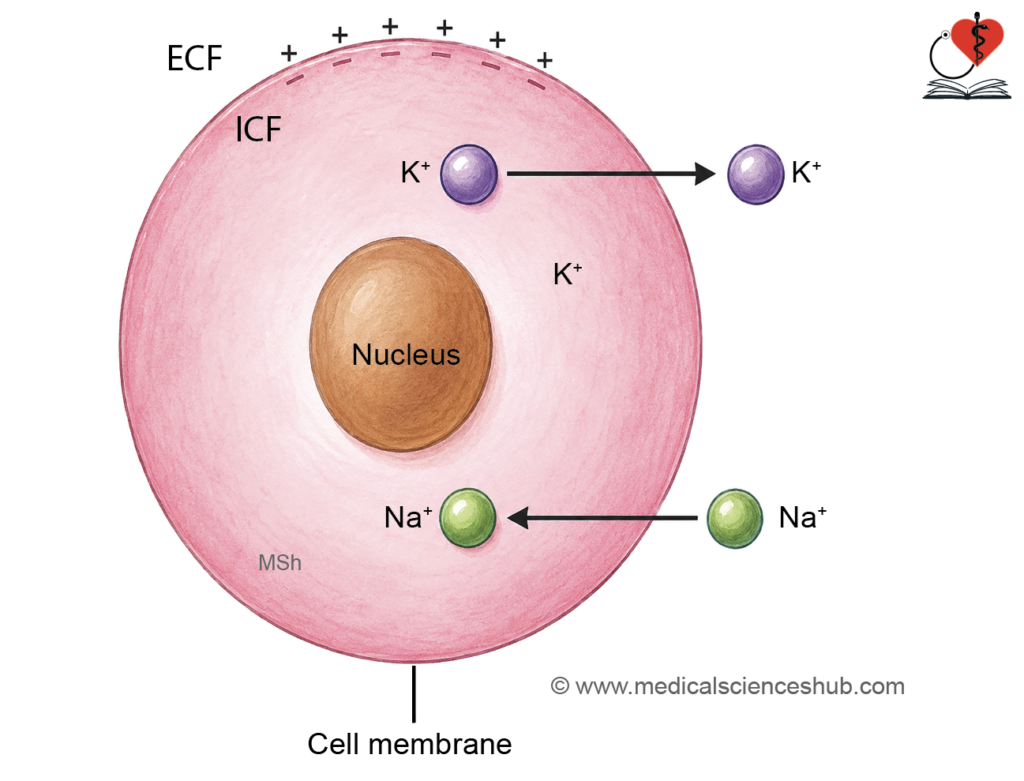
- Potassium concentration is higher inside the cell than outside.
- The membrane is highly permeable to potassium at rest.
- Potassium diffuses outward down its concentration gradient.
- This outward movement leaves negative charges inside the cell.
Role of Sodium Permeability
- Sodium concentration is higher outside the cell.
- Sodium tends to diffuse inward along its gradient.
- However, membrane permeability to sodium is low at rest.
- Sodium entry is insufficient to counter potassium loss.
Role of Anions
- Intracellular proteins and organic phosphates are non-diffusible anions.
- These negative charges remain inside the cell.
- They contribute to the overall negativity of the intracellular environment.
Role of Sodium–Potassium Pump
- The sodium–potassium pump maintains ionic gradients.
- It actively transports three sodium ions out and two potassium ions into the cell. This creates a net loss of positive charge from the cell.
- The pump is electrogenic and supports membrane negativity.
- Negativity is only along the membrane: Only a small fraction of ions generates the membrane potential. Overall intracellular fluid remains electrically neutral. Charge separation occurs only near the membrane. Thus, negativity is localized close to the cell membrane.
Maintenance of RMP
- The sodium–potassium pump maintains ion gradients across the membrane.
- It removes sodium entering the cell and restores intracellular potassium. This prevents dissipation of concentration gradients and sustains membrane potential.
Recording of Membrane Potential
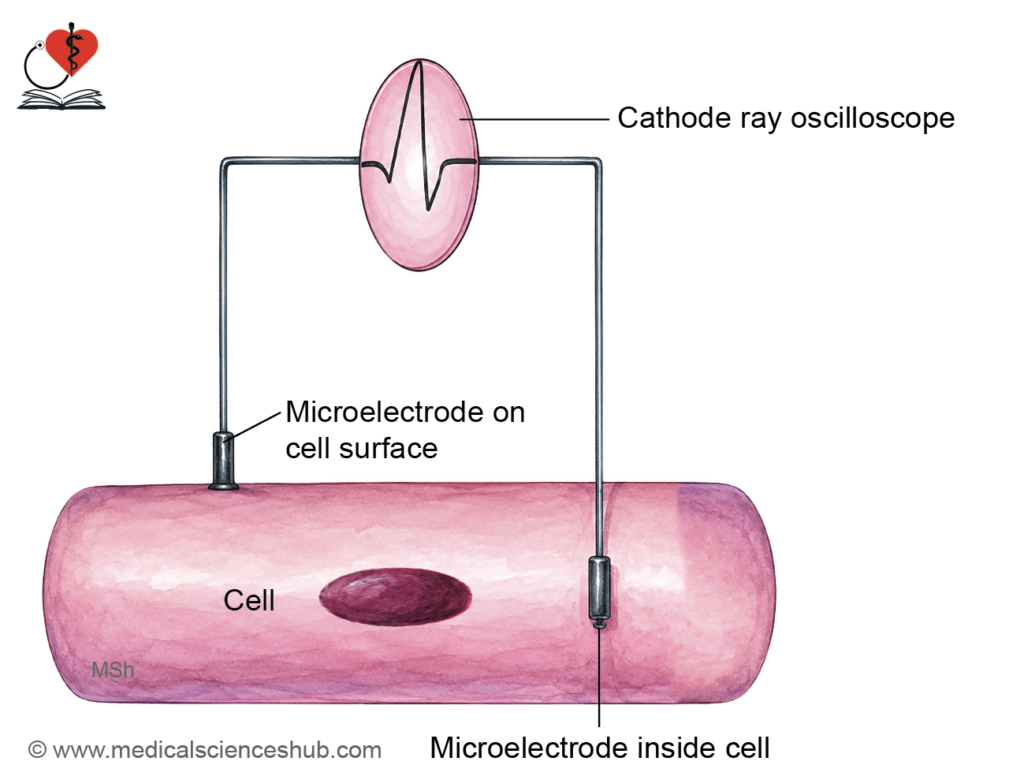
- Membrane potential is recorded using microelectrodes.
- Signals are amplified by electronic amplifiers.
- A cathode ray oscilloscope displays the recorded potential.
Basic Principle
- Two microelectrodes are placed, one outside and one inside the cell. A potential difference of about −70 millivolts is recorded. This indicates the resting membrane potential. It reflects the polarized state of the cell membrane.
Important Questions
- Define resting membrane potential.
- Write a short note on resting membrane potential.
- Explain the generation of resting membrane potential.
- Describe the maintenance mechanisms of resting membrane potential.
- Write a short note on the role of sodium-potassium pump in resting membrane potential.
- Mention the normal value of resting membrane potential in neurons.
- Define equilibrium potential.
- Write the equilibrium potentials of sodium, potassium, and chloride ions.
- Write a short note on Gibbs–Donnan equilibrium.
- Define Gibbs–Donnan equilibrium.
- Explain the significance of Gibbs–Donnan equilibrium.
- Define Nernst equation.
- Write a short note on Nernst equation.
- Mention the applications of Nernst equation.
- Define Goldman–Hodgkin–Katz equation.
- Write a short note on Goldman–Hodgkin–Katz equation.
- Differentiate between Nernst equation and Goldman–Hodgkin–Katz equation.
- Explain the ionic basis of resting membrane potential.
- Write the factors affecting resting membrane potential.
- Describe the principles of membrane potential recording.
- Write a short note on intracellular recording of membrane potential.
- Mention the importance of membrane permeability in resting membrane potential.
- Explain why potassium ions contribute more to resting membrane potential.
- Define membrane potential.
- Write a short note on equilibrium potential of ions.
📝 Test Your Knowledge – Practice MCQs
Attempt the chapter MCQ quiz and assess your understanding of key concepts.
Click to see: Medical Disclaimer and Copyright Notice